
Do you have any posts on your feed in LinkedIn that remind you of something you have read before? It could be the post about the principles of leadership or the necessity of consistency. The wording could be different, but the idea the post conveys would sound familiar to you.
People tend to underestimate the level of similarity of posts on LinkedIn. The network is filled with entrepreneurs who teach others how to create businesses. They talk about their experience and what lessons they have learned during their career. The topics are pretty interesting, most posts are the same. It makes it impossible for people to differentiate one founder experience from another.
It creates a problem for the founders who should promote themselves through LinkedIn. Your posts on the network should contain information about your experience and your own perspective on things. You cannot copy anything that other people post on their profiles. Effective personal brand development can help you deal with this problem. It can make your posts more organised and help you express yourself clearly.
Why Does So Much Founders Content Sound the Same?
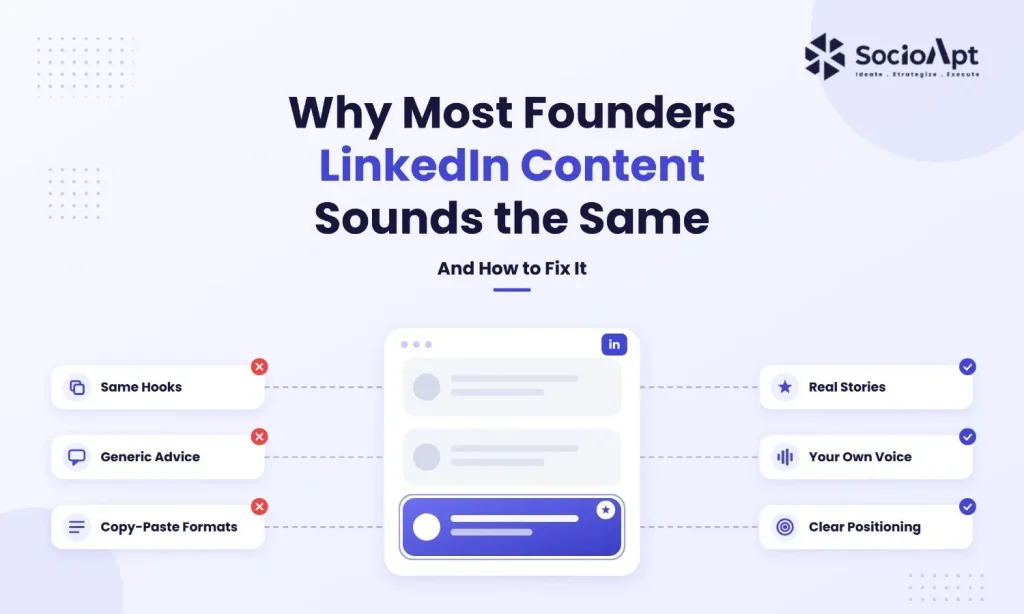
Founders don’t try to copy one another. The issue begins when they all get the same advice regarding content creation. Founders are encouraged to teach lessons learned along the way. Founders are advised to talk about business and leadership. In addition, founders may be advised to employ popular hooks and formats since the posts get attention.
All of these tips will prove helpful in the beginning of the game. But the trouble comes when founders adopt them all without putting their unique touch into them.
Here are a few reasons why this happens.
1. Everyone Follows the Same Content Trends
These LinkedIn patterns may influence how the founder creates the content for a particular post. If one pattern has been working well with one kind of posts, the founders will repeat the process.
The founder can create a post with an amazing opening line, stating the fact of failure. This means that the post will have three lessons that are learned from failure and end with a question. All other founders begin repeating the same pattern. Copying trends like this is one of the most common mistakes founders make on LinkedIn, and it is easy to fix once you spot it.
2. Founders Share Advice Without Enough Personal Context
There is plenty of advice on LinkedIn concerning business growth. It ranges from the importance of finding the right people to tips on time management. Also, you can find information about creating customer trust. These issues are relevant and important, but the manner of presenting them matters.
For example- two entrepreneurs have decided to write about the process of hiring. One of them writes about the significance of finding the right people for business growth. The other describes how hiring a person with an alternative set of skills helped to overcome the obstacle that slowed down the whole project. Both of them discuss hiring, but the second entrepreneur gives more insight into experience.
3. Founders Try Too Hard to Sound Professional
It is natural for most entrepreneurs to desire an impeccable profile on LinkedIn. It is possible for them to use professional language or jargon in their writing since they think that this way they will seem more experienced. Sometimes content becomes impersonal if every line sounds like it’s straight out of a corporate presentation.
You don’t have to use difficult vocabulary to demonstrate your knowledge of the field. Simplicity in language might enhance the applicability of your thoughts.
Describe everything like you would tell your friend about the event that took place. Explain how it happened and what the results were.
4. They Talk About Success but Leave Out the Difficult Parts
LinkedIn is famous for showcasing the brighter side of entrepreneurship. The entrepreneur will talk about the achievements made by the team. The focus will be on how you made those achievements or brought in new products.
This might be something worth sharing, but when you know something about the journey that leads to such an achievement, you connect more with it.
There is no need for you to share anything confidential or any problems that you face. Even talking about a failed strategy or learning from it would be fine.
How to Make Your LinkedIn Content Sound More Like You
You do not need to post every day or come up with a completely new topic each time. You need a clear idea of what you want people to remember about you.
Here are a few ways to make your content more personal and useful.
1. Start With a Clear Personal Brand Strategy
Before creating the next post in LinkedIn, you should give some thought to your professional identity first.
Answer only three questions.
- What do I want to be known for?
- Who are those people whom I want to reach out to via my posts?
- What is the experience/perspective that I have which could help them?
The above questions will guide you in selecting the topics for your post and how you would go about it.
For example, an entrepreneur of a tech company would want to be known for his proficiency in simplifying technology choices. The co-founder of the company may wish to talk about experiences of managing sales and relationships with clients for startup companies. While both of them could talk about business growth, their perspectives on the subject matter will differ greatly. A professional personal branding strategy will help you get the answers to the above questions prior to writing the post.
2. Work on Your Personal Brand Positioning
Positioning for Personal Branding is about how you want people to see yourself and your capabilities.
The following are some strategies on how you can effectively position yourself:
- Identify your competitive advantage: Identify the issues you solve and the type of clients that you deal with.
- Identify your selling points: Describe your experience and how you differentiate from other people in the same field.
- Identify your target audience: Some marketers may be specialized in making sure that the small business is seen online while other marketers can be specialized in growing the brand of the big company through marketing.
- Make sure that your messages are consistent: It means that both your LinkedIn Headline and your messages should say the same thing.
3. Use Your Personal Brand Values to Guide Your Content
Your personal brand values will shape your communication and decision-making process, which will allow people to know your values as an entrepreneur. It is crucial for you to realize your values. For instance, you can be an entrepreneur who values transparency with your clients or an entrepreneur who values an opportunity to discuss all decisions with a small number of people. Maybe, you value the relationship with your clients rather than quick profits. All these values can become an organic part of your story.
For example, if you value transparency, you can share a story about how you solved a problem with your client. If you value cooperation, you can share a story about a situation when you took into account the opinion of your employees while making decision.
4. Share Real Experiences Instead of General Advice
The activities that you carry out at your work can be used as material for writing LinkedIn articles.
Below are some tips how you can use your experience as a basis for writing LinkedIn articles
- Write about your experience: Write about your experience of working with your client and having discussions in a team meeting on something that helped you acquire useful knowledge.
- Be specific: Do not provide any general advice on dealing with feedback from clients. Rather tell about your actions and how you improved your product/service.
- Discuss three topics:
- What happened?
- What have you learned from it?
- How will it affect your future work?
- Disclose your failures: Tell people about your failures and how you would behave today to help other startup owners reconsider their decisions.
- Do not disclose any personal information: Do not disclose any confidential information and ask for permission of your client or employee to write about.
5. Build a Few Content Themes You Can Return To
There is no need to change the theme for each piece of writing that you write. Select some themes that will be in line with your skills and your audience.
For example, the founder of the company may take the following topics:
- Something he or she has learned during management of the company
- Problems facing the customers
- Issues influencing the productivity of the founder’s team
- Something happening in the founder’s business industry
Experiences which influenced the development of working style.
You may discuss the same theme but from different angles. The founder who decides to write about methods of hiring new employees may write about the experience of the latest recruitment. In another article, the founder can describe how he or she helps newbies to integrate into the team.
6. Stop Measuring Every Post by Likes
Although engagement will tell you what is going on with your content, likes will not tell you if your personal brand works. Let’s have a look at some of the things to take into account:
- Don’t trust likes: Posts with no likes at all may become a great starting point for a productive conversation with a potential client.
- Listen to your audience: Find out if there are any people asking any questions regarding your professional services.
- See who interacts with your content: It would be better for you to hear from potential clients and professionals of your industry rather than getting numerous reactions.
- Analyze your content regularly: Find out what themes get any response and use them for your future content posts.
- Target the right audience: You shouldn’t try to make popular posts; you should focus on the right people with your experience and skills.
How SocioApt Can Help Founders Create a Clearer LinkedIn Presence
It can become a challenging task to produce content consistently when running a business at the same time. You might have an idea of what you are doing in the field but find it difficult to express what makes you special. Here is where having a good personal branding strategy could assist. It will enable you to connect your professional positioning with the content that you post and how you communicate it.
At SocioApt, we help business founders establish strong personal brands by positioning themselves and developing relevant social media strategies. Our focus is on helping founders present their expertise through professional and clear content.
Instead of posting just for the sake of being active on social networks, you could move on to building your personal brand in a more professional manner. In this case, you can use your profile to define what you do while the content you produce reflects your thinking.
The Bottom Line
It is difficult for followers to recall which founder said what when LinkedIn content becomes similar. Adapting to trends and providing advice that can benefit many may help you to be present on the platform, but it will not necessarily showcase what makes you unique. At SocioApt, we believe personal brand strategy makes your content more purposeful. You get to know your audience better and write about the topics that you have experience in. The personal brand positioning tells people what you would like to become famous for, and the personal brand values will make it clear how you should do it.
Frequently Asked Questions
1. Why is there so much repetition in founders’ LinkedIn posts?
Since many founders adhere to the same content trends and give generalized advice on business growth or leadership, it is easy for the posts to become repetitive in the absence of personal experience and perspective.
2. What is the role of a personal brand strategy in a founders’ LinkedIn posts?
Personal brand strategies assist founders in defining their brands and audience. Personal brand strategies also give direction to the content, ensuring that the posts have a consistent message.
3. Explain the difference between personal brand positioning and personal brand values.
Personal brand positioning is a means to articulate how you would like to be perceived using your expertise and style. Personal brand values are the values by which you will be guided to make decisions and communicate.
4. What is the posting frequency on LinkedIn for founders?
There is no one solution fits all when it comes to posting frequency on LinkedIn. Select an appropriate frequency at which you can post quality posts without interfering with other activities.
5. Is it possible for the founders to make LinkedIn content using AI without compromising on the authenticity of their voice?
Yes. AI technology could help to arrange the ideas or even to edit the draft. But the founder needs to put his/her personal experience and opinion to it and then to thoroughly proofread the draft. This content needs to express their views rather than generic ones.
6. How can SocioApt benefit the founders in building their personal LinkedIn brand?
SocioApt can help founders strengthen their personal brand through social media strategy and personal branding services. It can help them communicate their expertise clearly and create content that reflects their experience and business goals. With the right positioning and a consistent content plan founders can improve their professional visibility and connect with the right audience