
Most businesses think of inbound marketing as blog posts, SEO, and email sequences. Social media gets treated like a separate thing, a broadcasting tool, something you use to push out content and hope people engage.
That’s the wrong way to think about it.
Social media isn’t separate from inbound marketing. It’s one of the most important channels within it. When done right, it does what inbound marketing is supposed to do: attract people who are already interested, build trust before any sales conversation happens, and bring potential customers into your world on their own terms.
This blog breaks down exactly why social media belongs at the center of your inbound strategy and how each channel contributes to that goal.
What Inbound Marketing Actually Means?
Before getting into social media’s role, it’s worth being clear on what inbound marketing is, because the term gets used loosely.
Inbound marketing is the practice of attracting customers through content and experiences that are useful to them, rather than interrupting them with ads they didn’t ask for. Instead of chasing people, you create reasons for them to come to you.
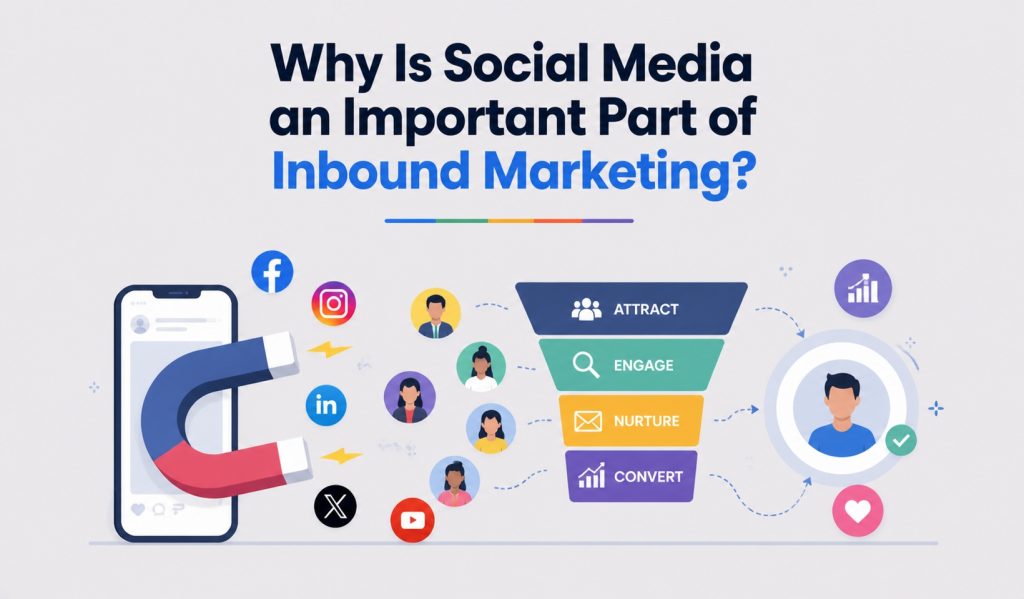
The classic inbound funnel works in three stages. First you attract strangers and turn them into visitors. Then you convert those visitors into leads. Then you close those leads into customers. Social media plays a role at every single one of those stages, which is why treating it as an afterthought is a mistake.
Understanding what is social media marketing and how it fits within a broader marketing strategy is the starting point for building something that actually works, rather than just staying busy online.
Social Media Puts Your Content in Front of People Who Weren’t Looking for You Yet
Search engine optimization works when someone already knows they have a problem and types it into Google. Social media works earlier than that.
A potential customer scrolling Instagram or LinkedIn hasn’t necessarily searched for what you offer. But if your content shows up in their feed and speaks directly to a problem they’re dealing with, you’ve entered their awareness without spending a rupee on ads.
This is one of the most valuable things social media does for inbound marketing. It creates discovery. A well-crafted LinkedIn post about a common mistake your target audience makes, a short Instagram Reel showing a result your product delivers, or a Facebook post that answers a question your ideal customer asks all the time, these reach people before they’re actively shopping.
And when those people do start shopping, they already know your name. That familiarity is worth more than most brands realize.
It Builds Trust Before Your Sales Team Says a Word
Inbound marketing is built on the idea that trust drives conversions. People buy from brands they believe in, and belief takes time and repeated exposure to build.
Social media accelerates that process in a way no other channel can.
When someone follows your brand on Instagram or LinkedIn for three months and consistently sees content that helps them, entertains them, or shows them real results, they arrive at a sales conversation already half-convinced. The friction is lower. The skepticism is lower. The time to close is shorter.
Compare that to a cold ad or a cold email where the prospect knows nothing about you. The conversion rate difference is significant, and it’s entirely because of the trust that social media builds passively over time.
This is why consistency matters more than virality. One post going viral does nothing for trust. Showing up with useful, relevant content for 90 days builds the kind of relationship that turns followers into buyers.
Social Media Drives Traffic to Your Inbound Assets
Blog posts, lead magnets, landing pages, webinars, free tools, all of these are inbound assets that need traffic to work. Social media is one of the most effective ways to send that traffic.
A blog post that took five hours to write will get found slowly through SEO over months. That same blog post shared on LinkedIn with a compelling hook, or turned into a carousel that drives people to click the link in bio, can get 500 visits in 48 hours.
This is how smart inbound marketers use social media: not as the destination, but as the distribution channel. The content lives on your website or landing page. Social media is how you get people there.
Short-form video works particularly well for this right now. A 45-second Reel or TikTok that teases the insight from a longer blog post, with a clear call to action to read the full version, consistently drives more clicks than a static link share. The platform rewards native video with reach, and you get the traffic.
It Turns Your Audience Into a Lead Generation Channel
Most businesses treat social media followers as a vanity metric. The follower count looks good in reports but doesn’t connect to revenue.
The brands that get inbound marketing right use their social following as an active lead generation tool.
Here’s how that works in practice. You create a piece of content that delivers genuine value, a framework, a checklist, a breakdown of something your audience finds complicated. At the end, you offer a deeper version of that content in exchange for an email address. You promote it consistently across your social channels. Followers who are ready to go deeper opt in, and they enter your inbound funnel as warm leads.
This is the social media to email pipeline, and it’s one of the highest-ROI moves in inbound marketing. The leads coming through it are warmer than any cold outreach because they chose to hear from you.
The best social media marketing services build this pipeline deliberately, not just posting content and hoping something converts, but creating a clear path from follower to lead to customer that’s tracked and optimized over time.
How Different Social Media Channels Contribute to Inbound Marketing?
Not every platform does the same job. Here’s how each major channel fits into an inbound strategy.
LinkedIn is the strongest inbound channel for B2B businesses. Long-form posts, carousels, and short videos that share expertise attract decision-makers who are already thinking about the problems you solve. LinkedIn’s search function also works like a mini search engine, making thought leadership content discoverable by people who’ve never heard of your brand.
Instagram works best for building brand trust and showcasing results. Before-and-after content, behind-the-scenes clips, customer stories, and Reels that demonstrate your product or service in action move people from awareness to consideration faster than most other content formats. Instagram is also where user-generated content (customers tagging you, sharing their results) acts as organic word-of-mouth that reaches new audiences.
YouTube is the second-largest search engine in the world. Long-form educational videos on YouTube rank in Google search and stay relevant for years. For inbound marketing, YouTube is a long-game channel: tutorials, how-to videos, product walkthroughs, and Q&A content attract people who are actively researching solutions, which makes them high-intent prospects.
Facebook still has the largest user base of any social platform, and its strength in inbound marketing lies in community and targeted distribution. Facebook Groups built around a topic your brand owns create an owned community that you can market to without algorithm interference. Facebook’s ad targeting, when used to amplify organic content to warm audiences, is one of the more cost-efficient distribution tools available.
TikTok and Instagram Reels are where discovery happens at scale right now. Short-form video gets more organic reach than any other format across most platforms. For inbound marketing, these channels are most valuable at the top of the funnel: getting your brand in front of new audiences who didn’t know they needed what you offer.
Social Listening Is an Underused Inbound Tool
Most brands use social media to broadcast. The smarter move is to also use it to listen.
Social listening means tracking what your potential customers are saying on social media: the questions they’re asking, the frustrations they’re expressing, the language they use to describe their problems. This is free market research that most businesses ignore.
When you know exactly how your audience describes their problems, you can create content that answers those exact questions in those exact words. That content ranks better in search because it matches search intent. It resonates better on social because it sounds like something they’d say themselves.
Comments on competitor posts, Reddit threads in your niche, questions in LinkedIn posts, Facebook Group discussions: all of these are windows into what your audience actually wants to know. Build your inbound content strategy around what you find there and your content will consistently outperform brands that guess.
Social Proof on Social Media Shortens the Inbound Buying Cycle
One thing social media does that no other inbound channel replicates as well is social proof at scale.
When a prospect is considering buying from you and they check your Instagram and see 200 posts, real customers sharing results, team content, behind-the-scenes clips, and consistent value, that profile does more convincing than a sales page.
Customer testimonials posted as video clips or quote graphics, case study carousels that walk through a real client result, and UGC (user-generated content) from customers who tag your brand all serve as third-party validation. And third-party validation converts better than anything you say about yourself.
This is why growing your social presence isn’t just a vanity exercise. A strong social media presence actively shortens the time between a prospect discovering your brand and deciding to buy.
Putting It Together
Social media is important to inbound marketing because it does the work that inbound marketing is designed to do: attract the right people, build trust over time, and create a path to conversion that doesn’t depend on interrupting someone’s day with an ad they didn’t want.
The channels are different, the content formats are different, and the timelines are longer than most brands are patient enough for. But the businesses that treat social media as a core part of their inbound strategy, not an afterthought, consistently out-convert the ones that don’t.
Frequently Asked Questions:
How does social media support inbound marketing?
Social media supports inbound marketing by attracting new audiences through organic content, building trust through consistent and valuable posts, driving traffic to inbound assets like blogs and landing pages, and generating leads through social-to-email pipelines. It covers the top and middle of the inbound funnel better than almost any other channel.
Which social media platform is best for inbound marketing?
It depends on your audience. LinkedIn is the strongest for B2B inbound marketing. Instagram and TikTok work best for B2C brands focused on awareness and trust-building. YouTube is the best long-term inbound channel because video content ranks in search and stays relevant for years. Most inbound strategies use two or three platforms rather than trying to be everywhere.
How is social media marketing different from inbound marketing?
Inbound marketing is the overall strategy of attracting and converting customers through useful content and experiences. Social media marketing is one of the channels within that strategy. Other inbound channels include SEO, blog content, email marketing, and lead magnets. Social media works best when it’s connected to those other channels rather than running as a standalone effort.
How long does it take for social media to generate inbound leads?
Most businesses start seeing inbound leads from social media within 3 to 6 months of consistent, targeted activity. The timeline depends on how well your content matches your audience’s interests, how frequently you post, and whether you have a clear path from social content to a lead capture mechanism like a landing page or email opt-in.
What type of social media content works best for inbound marketing?
Educational content that answers real questions your audience has, customer success stories, behind-the-scenes content that builds trust, and short-form video that drives awareness all perform well for inbound purposes. The common thread is that the content should give value first, with conversion being a byproduct of that value rather than the opening move.