
There are marketing frameworks that sound clever in a tweet and fall apart the moment you try to use them. And there are frameworks that are simple enough to remember but deep enough to actually change how you work.
The 3-3-3 rule is the second kind, if you understand what it’s actually asking you to do.
Most articles about it tell you what the three numbers mean and send you off to apply it. Knowing the rule isn’t the hard part, though. Knowing why it works, where it breaks down, and how to actually build it into your marketing, that’s where most people get stuck.
What Is the 3-3-3 Rule in Marketing?
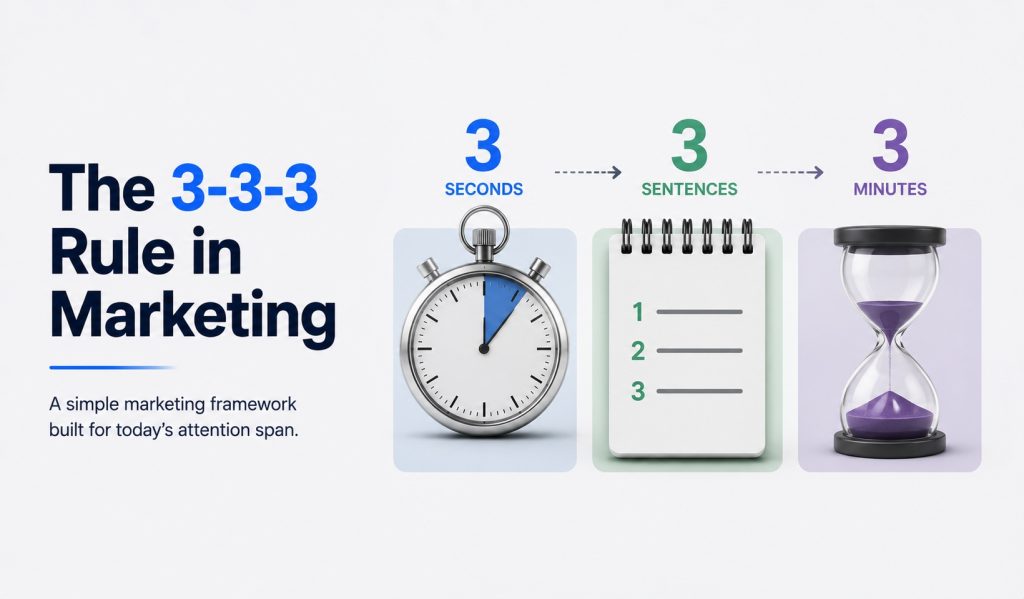
The 3-3-3 rule is a framework that says your marketing, whether it’s an email, a social media post, or a landing page, needs to do three things in three seconds, three sentences, and three minutes.
Here’s what each layer actually means:
- 3 seconds — the time you have to stop someone from moving on. This is the hook. The subject line, the opening visual, the first line of copy. If you don’t grab attention in three seconds, nothing else matters because nobody sees the rest.
- 3 sentences — the time you have to earn the next few minutes of someone’s attention. After the hook lands, your next three sentences need to give the reader a reason to stay. Not a summary of everything you’re about to say, a reason. A promise. A tension that makes them want to see how it resolves.
- 3 minutes — the average time a genuinely interested reader will give your content before deciding whether it’s worth their full attention or not. By the three-minute mark, they’ve made a judgment. Either they’re in, or they’ve moved on.
The rule isn’t about limiting your content to three minutes. It’s about structuring your content so the right reader self-selects within three minutes and stays. The wrong reader leaves, and that’s fine.
Where the 3-3-3 Rule Comes From
The framework draws from a few different places that researchers and marketers have been tracking for decades.
Microsoft’s 2015 attention span study found that the average human attention span had dropped to around eight seconds and follow-up research into digital behavior consistently shows that the first three seconds of any content interaction are the most decisive. Eye-tracking studies from Nielsen Norman Group show that people scan web pages in an F-pattern, deciding within the first few lines whether the content is worth reading.
The “three sentences to earn attention” piece borrows from direct-response copywriting. David Ogilvy, whose agency built some of the 20th century’s most effective advertising, was obsessed with the opening. His rule was that the headline and the first paragraph were worth more than everything that followed combined because if those didn’t work, nobody read the rest.
The three-minute mark comes from content analytics. HubSpot’s research on blog engagement found that the average reader decides whether to commit to a piece within the first few hundred words. Once someone passes the three-minute engagement mark on a piece of content, time-on-page and conversion rates both go up sharply.
Put those three bodies of research together and you get a framework that isn’t invented out of thin air; it’s built from real patterns in how people actually consume content online.
The 3-3-3 Rule in Email Marketing (This Is Where It Gets Specific)
Email is where the 3-3-3 rule is most commonly applied and where getting it wrong is most expensive.
Your average email recipient spends less than three seconds deciding whether to open your email. That decision happens entirely based on three things: who sent it, the subject line, and the preview text. Most email marketers obsess over the subject line and completely ignore the preview text. That’s a mistake. The preview text is the second sentence of your three-sentence hook, and it’s free real estate most people waste.
The 3-second hook in email breaks down like this:
- Subject line = the headline (your one shot to create enough curiosity or urgency to earn the open)
- Preview text = the subhead that makes the headline work (the sentence that confirms the subject line wasn’t clickbait)
Bad: “Our monthly newsletter is here!” / “Click to read inside.”
Better: “You’re pricing your services wrong” / “Most freelancers undercharge by 40%. Here’s the math.”
The second version uses the subject line to create a specific claim and the preview text to back it up with a number. That combination is what earns the open.
The 3-sentence body opener is where most emails lose people who actually opened them. Once they’re in, you have three sentences before they decide to read or delete. Those three sentences should do three specific things:
- Deliver on the promise of the subject line, don’t bait-and-switch
- Add a specific detail that makes the promise feel real, not vague
- Set up what’s coming next in a way that makes them want it
Compare these two openers, both are exactly three sentences:
Weak: “Today we’re talking about pricing. A lot of service providers struggle with this. We’ve put together some tips to help.”
Strong: “Most freelancers I talk to are undercharging by at least 30%, and they know it. The problem isn’t information. It’s that every time they try to raise their rates, they talk themselves out of it before the conversation even starts. This email breaks down the exact moment that happens and how to get past it.”
One gives the reader a reason to stop. The other gives them a reason to continue.
The 3-minute body is your last layer. The first 300 words of your email should do the heavy lifting. By the time someone has read for three minutes, they should know exactly what you’re offering, why it matters to them, and what you want them to do. Not at the bottom. Within the first three minutes. This is why long emails often fail, not because they’re long, but because the payoff is buried.
The 3-3-3 Rule in Social Media Content
On social media, the three-second window is even more brutal. People are scrolling at roughly 300 words per minute and processing images in 13 milliseconds. Your hook isn’t just competing with other brands, it’s competing with memes, breaking news, friends’ posts, and a dozen other notifications firing at the same time.
The 3-3-3 rule on social media works like this:
3 seconds, the first line of your post (on LinkedIn or X) or the first visual frame (on Instagram or TikTok) needs to stop the scroll. Not with a question nobody cares about, but with a statement specific enough to create an immediate reaction.
Posts that stop the scroll tend to look like this:
- “I ran the same ad for six months and it outperformed every ‘creative’ we tested.”
- “The advice I got from my first mentor was wrong. Here’s what I figured out after losing $30,000.”
- “Nobody talks about the part of going viral that actually hurts your business.”
Posts that don’t stop the scroll tend to look like this:
- “Marketing is changing fast. Here’s what you need to know.”
- “5 tips to grow your brand in 2025.”
- “The importance of consistency in content creation.”
The difference is specificity and stakes. The first set makes you feel like you’re about to learn something you can’t get anywhere else. The second set sounds like every other post you’ve seen.
3 sentences on short-form platforms, your first three sentences are your entire post. On longer platforms, they’re your hook paragraph. Either way, they need to deliver a complete idea or create enough tension that reading further feels necessary, not optional.
3 minutes for video content (TikToks, Reels, YouTube Shorts), this becomes a three-minute opportunity. If someone watches past 60 seconds of a short-form video, they’re highly likely to watch to the end. Your job in the first 60 seconds is to earn the next 60 not with a teaser (“stay to the end for the good stuff”), but with immediate, specific value that makes them trust the rest is worth it.
If you’re thinking about how this connects to your broader content operation, this post on social media marketing strategies for small businesses breaks down how to build the system around frameworks like this one.
The 3-3-3 Rule in Landing Page Copy
Landing pages are where the 3-3-3 rule pays its biggest dividends and where most businesses are quietly leaving money on the table.
3 seconds, your headline and hero image are doing all the work here. People don’t read landing pages. They scan them. The headline needs to answer one question: “Is this for me?” Not “what does this company do?” That’s secondary. “Is this for me” comes first.
A headline like “Professional Marketing Services” doesn’t answer that. A headline like “Social Media Marketing for Dental Practices That Want More Booked Appointments, Not Just More Followers” does. The second one is longer, but it earns the next three seconds of attention because the right reader immediately feels seen.
3 sentences below your headline, your subheadline and the first line of body copy are your three sentences. They need to do three things in order:
- Confirm who this is for. Specificity builds trust faster than any claim you can make about yourself
- Name the problem you solve in terms the reader would use themselves, not in your internal language
- Give a concrete reason to believe you can actually solve it, a result, a client win, a number
3 minutes, a well-structured landing page delivers its full argument within a three-minute read. That means the problem, the solution, the proof, the offer, and the call to action are all reachable before someone loses interest. If your most important proof point (a case study, a specific result, a testimonial with real numbers) is buried below the fold where most people never reach it, move it up.
What the 3-3-3 Rule Doesn’t Tell You
Every framework has limits. The 3-3-3 rule has two worth being honest about.
It’s about structure, not substance. You can apply the 3-3-3 rule perfectly, a sharp hook, a strong opener, a well-paced body, and still write boring content. The framework tells you where to put things. It doesn’t tell you what to say. A mediocre idea structured brilliantly is still a mediocre idea. Most people who struggle with content have a substance problem, not a structure problem, and no framework fixes that.
It assumes you know your audience. The 3-3-3 rule works because you’re optimizing for the right reader’s attention, not everyone’s. If you’re not clear on who you’re writing for and what they actually care about, the framework can’t compensate. A subject line that stops a freelance designer cold will scroll past a CFO without a second glance. Specificity first, structure second. Always.
How to Actually Apply This Starting Tomorrow
You don’t need to rebuild your entire content operation to use the 3-3-3 rule. You need to change three habits, and you can start all three this week:
- Audit your last five emails. Read just the subject line and preview text of each one. Would you open them if you received them cold? Now read just the first three sentences of the body. Do they give you a real reason to continue? If the answer to either question is no, you’ve found your starting point.
- Rewrite your hook before you publish anything. Before you post or send anything, look at the first line. Ask yourself: if someone saw only this, would they keep reading? If the honest answer is “probably not,” rewrite it until the answer is yes. This takes three minutes and it changes results more than anything else you can do.
- Move your best proof to the top. Whatever your most compelling data point, result, or testimonial is, put it in the first third of your content. Don’t save the good stuff for the end. Most people never get there.
If you want to understand how these content signals translate to actual business ROI, because applying a framework is one thing, but knowing whether it’s working is another, this breakdown is worth your time: How to Measure the ROI of Social Media Marketing.
One More Thing Nobody Tells You About This Rule
The 3-3-3 rule is ultimately about respect.
When you tighten your hook, you’re respecting the reader’s time. When you front-load your value, you’re trusting them enough to give them the good stuff early. When you structure your content so the right person self-selects in three minutes and the wrong person self-selects out, that’s not a conversion trick. That’s honest marketing.
The brands and individuals who build real audiences aren’t the ones gaming algorithms or chasing attention with empty hooks. They’re the ones who consistently show up with something worth reading, structured in a way that makes it easy to tell that it’s worth reading from the very first sentence.
That’s what the 3-3-3 rule is really about.
What to Do Next
If you’re working on building a content presence that actually converts, not just one that looks active, our Content Creation Services are built around frameworks exactly like this one. We work with businesses that are done posting and hoping, and ready to build something that consistently brings the right people in.
The 3-3-3 rule in short: You have three seconds to earn three more sentences. You have three sentences to earn three more minutes. Structure everything you publish with that in mind, and your content starts working harder without getting longer.
Frequently Asked Questions:
1. What is the 3-3-3 rule in marketing?
The 3-3-3 rule in marketing is a content structuring framework that breaks audience attention into three windows: three seconds to hook someone, three sentences to earn their continued attention, and three minutes to deliver enough value that they commit to the full piece. It applies to email, social media, landing pages, and most forms of digital content.
2. Where did the 3-3-3 marketing rule come from?
The 3-3-3 rule pulls from several bodies of research rather than one single source. Microsoft’s 2015 attention span study, Nielsen Norman Group’s F-pattern eye-tracking research, and HubSpot’s blog engagement data all point to the same pattern — that the first few seconds and sentences of any content determine whether someone stays or leaves. The framework formalizes what the data already showed.
3. How does the 3-3-3 rule apply to email marketing specifically?
In email marketing, the three seconds refers to the time a recipient spends deciding whether to open — based entirely on the sender name, subject line, and preview text. The three sentences refers to the opening of the email body, which needs to deliver on the subject line’s promise without burying the point. The three minutes refers to how quickly your email needs to make its full case before attention drops off.
4. Is the 3-3-3 rule the same as the rule of three in marketing?
They’re related but not the same. The rule of three in marketing is a rhetorical principle — the idea that information grouped in threes is easier to remember and more persuasive (think “stop, drop, and roll” or “location, location, location”). The 3-3-3 rule is a specific content structuring framework focused on managing attention across three time windows. Both use the number three, but they address different problems.
5. Does the 3-3-3 rule work for social media content?
Yes, and it’s especially relevant for social media because the attention window is narrower there than anywhere else. People scroll at around 300 words per minute on most platforms. Your first line of a post or first frame of a video is your three-second hook. Your first three sentences are your reason for someone to stop scrolling. And your first 60 seconds of video needs to earn the next 60 — which is roughly where the three-minute threshold plays out in short-form content.
6. Can the 3-3-3 rule improve conversion rates on landing pages?
It can, specifically by solving a problem most landing pages have: important proof points buried too far down the page. Most visitors never scroll past the fold, which means case studies, client results, and testimonials placed at the bottom get ignored. Applying the 3-3-3 rule means restructuring the page so your headline answers “is this for me?” in three seconds, your opening copy names the problem and the solution in three sentences, and your full argument — including your best proof — is reachable within a three-minute read.
7. What’s the biggest mistake people make when applying the 3-3-3 rule?
Treating it as a structure fix when they actually have a substance problem. The 3-3-3 rule tells you where to put things — it doesn’t make a vague idea specific or a boring insight interesting. The most common mistake is writing a perfectly structured piece of content that says nothing worth reading. The rule works when the underlying content is genuinely useful to a specific audience. It doesn’t rescue content that isn’t.
8. How long should a blog post or email be if I’m using the 3-3-3 rule?
The 3-3-3 rule doesn’t set a word count limit — it sets an attention threshold. A piece can be 500 words or 3,000 words. What matters is that the right reader can determine within three minutes whether it’s worth their full time, and that the most important information isn’t buried. Long content works when it’s structured so readers get value quickly. Short content fails when it buries the point even in a few hundred words.
9. How does the 3-3-3 rule relate to SEO and search rankings?
Google’s ranking signals increasingly reflect user behavior — specifically, whether people who click on a result actually stay and engage or immediately bounce back to the search results. A page that hooks readers in three seconds, earns their attention in three sentences, and keeps them for three minutes produces strong behavioral signals: low bounce rate, high time-on-page, and scroll depth. These aren’t direct ranking factors, but they correlate strongly with pages that rank well because Google reads them as signals that the content satisfied the search intent.
10. How do I know if the 3-3-3 rule is working for my content?
Look at three metrics. Email open rate tells you if your three-second hook (subject line and preview text) is working. Email click-through rate or post engagement tells you if your three-sentence opener is doing its job. And time-on-page or video watch time tells you if people are making it past the three-minute threshold. If your open rate is high but click-through is low, the opener is failing. If click-through is high but conversions are low, the body isn’t delivering on what the opener promised.