Most small business owners hit the same question sooner or later. You’ve been posting for a few months, the follower count has barely moved, and someone tells you to run ads. Someone else tells you ads are a waste of money and you just need better content. Social media for business gives small companies a way to connect with potential customers, share updates and build trust without needing a large marketing budget.
Both of these answers are partially right. Social media marketing via social media is not just about deciding which option to take out of the two, paid or organic marketing. It all depends on your present status in life, your budget, and your goals.
What Social Media Marketing for Small Business Includes
For small companies, social media marketing for small business involves using platforms like Instagram, Facebook, LinkedIn and YouTube to reach potential customers. It includes creating useful content, responding to comments and messages, sharing updates and promoting products or services to the right audience.
Social media marketing can be subdivided into two categories.
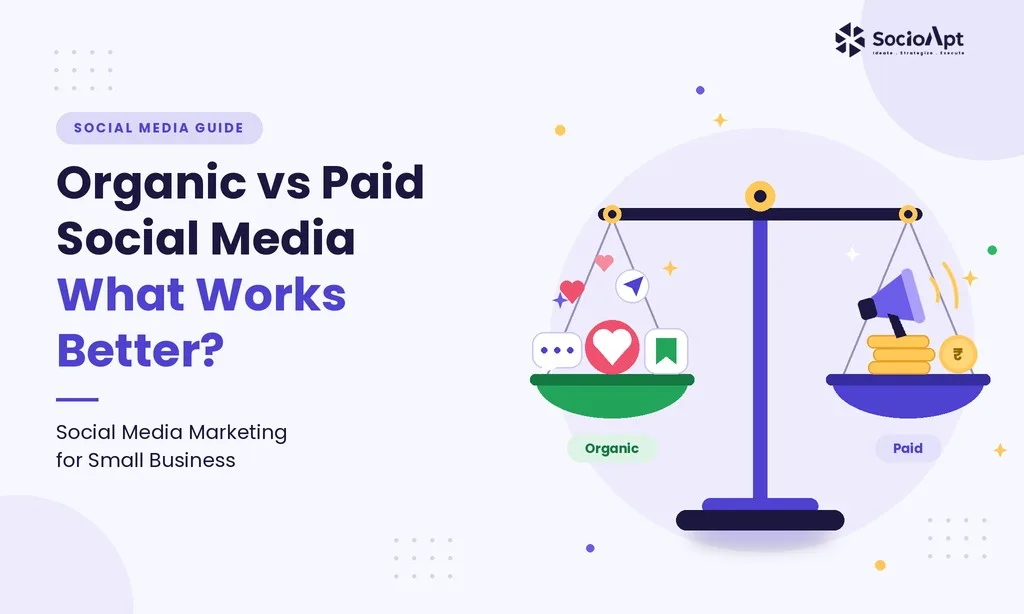
- Organic social media marketing is any marketing activity carried out without spending money on paid reach. You create content, some of your followers view it and at times the platform reaches out to other people.
- Paid Social media advertising involves paying for placing your post or advertisement in front of your chosen audience, regardless of their being your followers.
Most small businesses will eventually use both options. The more important question is what to focus on first.
Organic Social Media: What It Does Well and Where It Falls Short
Organic social media does not cost anything in terms of advertising budget, but it is not free. It costs time, and time is the resource that a small business owner is often short of. A normal weekly plan to prepare, film or design, publish and respond may take several hours or even the job of a part-time worker. Small businesses can also use Instagram Reels to reach new audiences and get more visibility through regular organic content
What it does well
- Establishes credibility gradually. When your follower has been seeing your posts for three months, is more likely to make a purchase than when just saw your ad once.
- Puts faces to your business. The behind-the-scenes videos, customer inquiries and tips give your business a face.
- Manages customer relations. Many consumers will contact the company via social media before calling or sending an e-mail.
- Works beyond publishing. Useful content will keep on being saved, liked or searched for months and years ahead.
In which areas it fails
- It is slow- It might take months rather than weeks before you notice its effects on sales.
- It has a limited reach- It rarely happens that a post is seen by all your subscribers and people unfamiliar with your account will be able to find it only if the social media algorithm chooses to.
- You cannot target it to certain people- You decide what you want to post but you do not have the control over who it will see.
- Algorithms can change- Something that used to be effective in promoting business last year may no longer work because of the changes in the social media algorithms.
Organic social media works well for business that can post regularly and have interesting things to share. For example, a beauty salon or fitness trainer can easily post about their services but businesses that give services like managing employee salaries find it difficult to create regular social media content.
Paid Social Media: What It Does Well and Where It Falls Short
Paid social media helps businesses reach more people through advertisements. You can choose who sees your ads based on their age, location, interests and online activity. You can also set how much you want to spend each day. Once your ad is approved, it can start reaching your selected audience within a few hours. Advertising on social media helps small businesses reach people beyond their existing followers. Platforms like Instagram, Facebook and LinkedIn allow businesses to target audiences based on their interests, location and behaviour
What it does better
- Fast access– Useful for the launch of a product or the opening of a new branch, may be time-sensitive as well.
- Specific targeting- May even be able to do specific ads for people in the vicinity of your store or people who visited your website the previous month.
- Testability– Use two different images or headlines and see what works better.
- Retargeting– Get back those people who saw your product but did not buy anything.
Where it comes up short
- It ends where the budget ends– As soon as you stop running your ads, the traffic comes to a halt.
- You need good products– Good targeting cannot compensate for poor web pages that don’t tell people what you do or how to get a hold of you.
- It is simple to spend unnecessarily– There is nothing more damaging than spending budget randomly on boosting posts without a goal.
- Prices differ– They depend on industries, cities and seasons, meaning any prices mentioned online could be different from yours. Start small and study your results.
Organic vs Paid Social Media Compare: Side by Side
| Organic social media | Paid social media | |
| Main cost | Time and content | Ad spend plus content |
| Speed | Slow (months) | Fast (days) |
| Control over audience | Low | High |
| Trust | Builds steadily | Starts lower, improves with repeat views |
| When you stop | Reach fades gradually | Reach stops almost at once |
| Best for | Brand, community, customer service | Launches, offers, lead generation |
| Tracking sales | Harder to link | Easier to link |
Which One Works Better for a Small Business?
Neither always wins. It will depend on your objective, your budget, and how much time you can give.
You are new to business, and your budget is small. Organic social media would be the starting point for you. You would get all your pages ready, post continuously for 60 to 90 days and get your pictures, reviews, and queries. Without any content and following base, there is nothing good for your advertisements to direct people to. You want customers today. Here paid social media would perform better, provided you are offering a clear proposition and have a landing page or contact number to turn inquiries into leads. Think about the new gym opening up in the vicinity, and a local advertisement can get to them in days.
Your product is researched before being purchased. It applies to the vast majority of business services and expensive purchases. Organic content creates authority, while the retargeting ads follow the visitor until they make a decision. In the LinkedIn case, the founder posts perform better than the company page. You post frequently and have some budget for the advertisements. Run paid ads behind the best performing organic content. Content that is already popular among the audience is a cheap and low-risk option to test out.
A Simple Way to Combine Both
It will work with practically all the small businesses that lack a large number of employees.
- Choose only 1 or 2 social media websites– Go where your audience is. For consumer-oriented businesses, it will be Instagram and Facebook. For B2B, it will begin with LinkedIn. It is better to use two social media sites brilliantly than 5 poorly.
- Publish at scheduled time– Most of the small businesses can post once or twice per week. You should make a mixture of useful information, customers’ stories, behind the scenes and promotions.
- See what posts work- Analyze what posts have been liked, saved, shared and clicked on.
- Promote the working posts– Set aside a small budget and start with the amount that you can afford to lose. Run the campaign for 7-14 days and select the goal, for instance, messaging, generating leads or visits to your website.
- Retarget the visitors– Advertise your services to people who already know about your company.
- Do it monthly– Keep working on what is effective and cut out everything else. Adjust the budget according to its effectiveness.
The right split between organic and paid depends on your numbers. Many businesses start with most of their effort on organic social media and a smaller share of money on ads, then shift the balance once they see what brings enquiries.
How Much Should a Small Business Spend on Ads?
There’s no magic number. Your market, location, and the level of competition affect how much a click or a lead will cost you. The way to go about it would be to choose a small amount of money that you’d never regret spending even if you gained nothing from it, to see what you’re spending per enquiry over two weeks, and if it turns out to be less than what the value of an enquiry is for you – you’ll have a reason to increase your budget.
Common Mistakes Small Businesses Make
- Posting without having any goal– Decide what you want messages, leads, visitors, or sales before spending money.
- Posts just for promotion– Whenever all your posts become about selling something, people will get bored.
- Planning for organic results in two weeks time– It is advised that two to three months should pass before judging.
- Redirecting traffic to a bad website– Make sure that your site is fast loading on mobiles and has a call to action button.
- Ignoring feedback through comments or messages– Responding is an important part of social media marketing for small business and delay in response means loss in sale.
- Counting on the number of likes– Likes make you happy but cannot buy you anything. Focus on inquiries and sales.
How to Measure What’s Working
Choose a set of key metrics for both types of social media and review their performance every month.
For organic social media: reach, saves, shares, profile visits, link clicks and messages received.
For paid social media: cost per click, cost per lead, cost per sale and return on ad spend.
Then connect these to real results. Add tracking links to your posts and ads, and ask new customers how they heard about you. A simple question on your booking or enquiry form does the job. Give each ad test at least a week or two before deciding, because early numbers can mislead.
It is also important to compare the results with your previous month’s performance. This helps you understand whether your content and campaigns are bringing better results over time. For example, if a post gets fewer likes but brings more website visits or enquiries, it may be more useful for the business.
Keep a record of which posts and ads perform well, what type of content gets the most response and where people are taking action. Use these observations when planning your next month’s content and advertising budget. The main goal is not just to get more views or followers but to understand whether social media is helping the business reach the right people and bring in potential customers.
The Bottom Line
Therefore, which path is better: organic or paid social media for the small business?
In the majority of cases, the choice will be organic content as the initial way. It will allow building trust, giving people more information about your brand. Meanwhile, paid social media will allow faster reaching the larger audience. First, choose one or two social media platforms according to your objectives and financial situation. Create and publish content regularly. Monitor its performance and invest a little money in promoting your most popular posts and ads. Analyse and change your strategy every month according to its efficiency. It is a quite simple social media marketing tool for the small business which does not require large expenses.
At SocioApt, we offer you creating a social media marketing strategy for your business considering your goals, audience and budget. Contact us and we will be glad to discuss your strategy.
FAQs
1. What are the distinctions between organic and paid social media marketing?
Organic social media means posting without paying for distribution. It takes time and builds trust. Paid social media implies that one pays to make his advertisement or content be reached by a certain audience. It is faster and allows greater control over the audience.
2. What choice should a small business make in terms of social media – organic or paid?
Neither will work all the time. Organics are good for building trust and audience engagement. Paid social media gives one quick results when something is going on like a product launch. Any small business would benefit from using organics at the beginning and then move on to paid social ads once it knows what its content is worth.
3. How much should a small business allocate for social media ads?
It depends on many factors and the company itself. Start with minimal budget that one can spend and lose over the period of two weeks. See what kind of price per inquiry your ads bring. If it is less than the value of the inquiry, this is a reason to spend more.
4. What time period does organic social media need to yield results?
Organic social media takes a lot of time to yield results. The usual duration of two to three months of consistent posting is required before you can start evaluating the performance of your business. Most businesses generate their leads only after consistently posting for 60-90 days, so do not expect any sales in the first two weeks.
5. Can I run both organic and paid social media simultaneously?
Yes, and it is highly effective for most small businesses. Start by posting your organic content and find out what kind of posts have been successful. After that, allocate some budget to the most successful posts for 7-14 days.