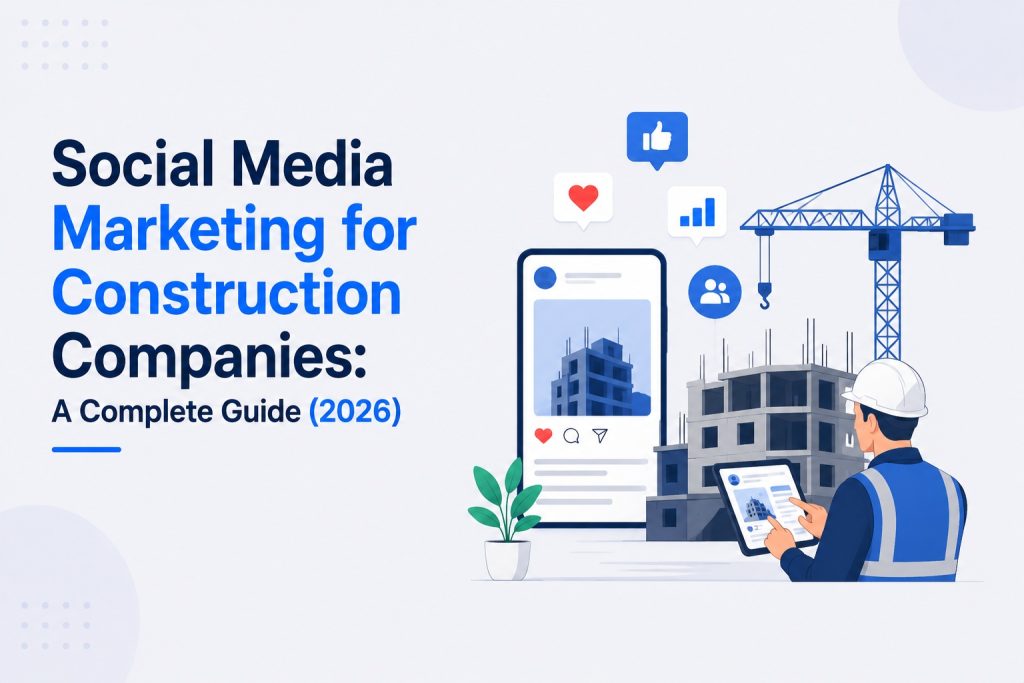
Most construction companies win work through referrals, relationships, and reputation. The problem is that all three of those things are invisible to anyone who does not already know you exist.
Social media changes that. It gives construction companies a platform to make their best work visible to thousands of potential clients, partners, and referral sources who would never find them through word of mouth alone.
This guide covers everything from what social media marketing actually means for construction, to why it matters, to the specific strategies that get results.
What Is Social Media Marketing for Construction Companies?
Social media marketing for construction companies means using platforms like Instagram, Facebook, LinkedIn, TikTok, and YouTube to promote your construction business, showcase completed projects, build brand credibility, and attract clients and partners.
It is not about posting motivational quotes or recycled industry news. It is about showing your actual work, the people behind it, and the results you deliver, consistently enough that the right people start to recognize and trust your brand before they ever call you.
For construction companies specifically, social media marketing covers:
- Posting project photos, progress updates, and completed build reveals
- Running targeted paid ads to homeowners or commercial clients in your local area
- Building a LinkedIn presence to connect with developers, architects, and project managers
- Sharing time-lapse videos, team spotlights, and behind-the-scenes job site content
- Collecting and amplifying client testimonials and reviews publicly
- Using social media to support recruitment of skilled tradespeople and site staff
It is both a brand-building tool and a direct lead generation channel when used with the right strategy.
Why Social Media Marketing Matters for Construction Companies
The construction industry has been one of the slowest sectors to adopt digital marketing. That is not a disadvantage. It is a window of opportunity.
When most of your competitors are not on social media, or are using it poorly, showing up consistently with strong content gives you a visibility advantage that takes years to close. In 2026, that window is still open for most construction businesses.
The data backs this up:
- 96% of people research a company online before making a purchase decision (Salesforce)
- 48% of construction firms say finding new clients is their single biggest business challenge (Dodge Data, 2025)
- LinkedIn has over 1 billion members including developers, architects, quantity surveyors, and procurement managers actively evaluating contractors (LinkedIn, 2025)
- Facebook reaches over 3 billion monthly active users, including homeowners and property buyers in every local market (Meta, 2025)
- Construction companies that post project content consistently generate up to 3x more inbound enquiries than those with no social presence (Houzz Pro, 2024)
Beyond the numbers, there is a behavioral shift happening. Homeowners and commercial clients now routinely check Instagram, Facebook, and Google before contacting a contractor. A company with no visible social presence, or one with an inactive account, loses credibility before the conversation even starts.
Social media marketing also fills the gaps that referrals leave. Referrals are unpredictable. Social media creates a consistent, searchable presence that generates leads even in months when word-of-mouth goes quiet.
Benefits of Social Media Marketing for Construction Companies
Understanding why social media matters is useful. Understanding what specific business outcomes it produces makes the investment decision much clearer.
Increased brand visibility in your local market
Every post you publish is an opportunity for people in your area to discover your business. Over time, consistent posting builds recognition so that when a homeowner or developer needs a contractor, your name is already familiar to them.
- Local hashtags and geo-tagged posts help your content surface in area-specific searches
- Active profiles appear in Google search results for branded queries
- Facebook and Instagram algorithms push relevant local content to users near your location
Direct lead generation without referral dependency
Social media turns passive viewers into active enquiries. A prospect who sees three months of your project content before reaching out arrives already convinced of your quality. That changes the sales conversation entirely.
- Instagram DMs and Facebook Messenger generate direct enquiries from interested prospects
- Paid ad campaigns on Meta can target homeowners by postcode, age, property type, and renovation intent
- LinkedIn connection requests and messages open doors with commercial clients that cold emails rarely do
Stronger trust and credibility before first contact
Clients making large construction decisions are risk-averse. They need to trust you before they commit. Social media builds that trust visually and publicly, through real project evidence rather than claims.
- Visible project portfolios replace the need to ask for references on every enquiry
- Client testimonials posted publicly signal that real people have hired you and been satisfied
- Safety content, certifications, and compliance posts reduce the perceived risk of engaging a new contractor
Competitive advantage over slow-adopting competitors
Most construction companies in most markets are still not using social media effectively. A business that builds a strong presence now owns the visibility in its niche while competitors catch up.
- First-mover advantage in local social media search results is significant and takes time for competitors to close
- A large library of project content builds domain credibility that cannot be replicated quickly
- Consistent posting history signals stability and longevity to prospective clients
Recruitment and talent attraction
Finding skilled tradespeople is one of the most persistent challenges in construction. An active social media presence showing a strong company culture, interesting projects, and a professional team attracts candidates who actively seek out employers they respect.
- LinkedIn job posts reach passive candidates not actively searching on job boards
- Instagram and TikTok job site content attracts younger tradespeople who evaluate employers on their social presence
- Culture content showing team recognition, safety standards, and quality of work differentiates you from generic recruitment ads
Supporting other marketing channels
Social media does not operate in isolation. It strengthens everything else your business does.
- Active social profiles improve your Google Business Profile ranking in local search
- Content shared on social drives traffic back to your website, improving SEO signals
- Email campaigns that point to recent project posts have higher click-through rates than those that do not
Choosing the Right Platforms for Your Construction Business
Not every platform deserves your time. The right choice depends entirely on who your client is and what type of work you do.
Instagram is the strongest starting platform for most construction companies because construction is inherently visual. Before-and-after photos, project Reels, and time-lapse builds all thrive here.
Best for:
- Residential builders, renovators, and fit-out companies targeting homeowners
- Landscaping, outdoor construction, and pool building businesses
- Any niche where the finished result is visually striking and shareable
Facebook remains essential for local service businesses. Its paid advertising targeting is the most precise available for reaching homeowners in a defined geographic area.
Best for:
- Roofing, plumbing, electrical, and general contracting businesses
- Running targeted local ad campaigns for seasonal or project-specific services
- Collecting and displaying reviews that appear in branded search results
LinkedIn is non-negotiable for commercial construction, civil engineering, and any business selling to other businesses rather than consumers.
Best for:
- Commercial builders and civil contractors targeting developers and project owners
- Subcontractors getting onto approved vendor lists
- Construction firms pursuing government, institutional, or large-scale tender opportunities
YouTube
YouTube is the most underused platform in construction and represents a real opportunity. Project walkthrough videos and time-lapse builds rank in both YouTube search and Google search.
Best for:
- Long-form project documentation
- Educational content positioning the company as a technical authority
- Recruitment and culture content showing the quality of work on site
TikTok
Construction content performs better on TikTok than most industry professionals expect. Time-lapse builds, transformation reveals, and job site day-in-the-life content regularly generate strong organic reach.
Best for:
- Residential construction companies comfortable with short-form video
- Businesses targeting homeowners aged 25 to 40
- Companies wanting fast organic reach without an advertising budget
To understand how each of these platform types functions as a marketing channel, this breakdown of types of social media marketing covers every approach in detail.
The Content That Performs Best for Construction Companies
The most important rule for construction social media content is simple: show the work. Everything else flows from that.
Before and after posts
Before-and-after content is the highest-engagement post type for construction companies on every platform. It tells a complete story in two images and earns the saves and shares that expand organic reach.
- Shoot the after with the same framing and lighting as the before for maximum visual impact
- Include a short caption describing the project scope, timeline, and client brief
- Post these as carousels on Instagram and LinkedIn for additional engagement
Project progress documentation
Regular progress content keeps your audience engaged throughout a build and creates a compelling archive of evidence that you deliver on complex projects.
- Weekly progress photos from the same angle show visible, cumulative change
- Short 30 to 60 second video walkthroughs at key milestones work well as Reels and TikToks
- Final reveal posts with before-and-after comparisons generate the highest individual post engagement
Time-lapse videos
A 30 second time-lapse compressing weeks of site activity is one of the most shared content types in construction. It requires nothing more than a phone on a fixed mount running a basic time-lapse app, and it showcases the scale and complexity of your work in a format people actually watch to the end.
Team and culture content
Clients hire people, not companies. Showing the tradespeople, project managers, and site supervisors behind your work builds the human connection that tips a prospect toward you over a competitor.
- Introduce team members with short clips or photo posts and include what they specialise in
- Highlight safety practices and site management standards to build confidence with larger clients
- Show team milestones, certifications completed, and long-serving staff to signal stability
Client testimonials filmed on site
A 30 to 60 second video of a satisfied client speaking at the completed project is more persuasive than any copy you will write. Ask for it before the site is cleaned up and the client has moved on.
- Include specific outcomes where possible: “completed two weeks ahead of schedule” or “on budget across an 18-month build”
- Tag the client’s business for commercial projects (with permission) to reach their network
- Use short clips as Instagram Reels and save the full version for YouTube and your website
Safety and compliance content
Posting about your certifications, safety standards, and compliance practices builds client confidence before a conversation starts. For larger residential and commercial clients, visible evidence of your safety culture reduces the perceived risk of engaging you.
Building Your Social Media Strategy: Step by Step
A strategy does not need to be complicated. It needs to be clear and consistent.
Step 1: Define who you are trying to reach
A residential renovation company targets homeowners aged 35 to 60 in a specific city with disposable income and a home they want to improve. A commercial subcontractor targets procurement managers, developers, and project managers at construction firms in their region. These are completely different people who require completely different content and platforms.
Step 2: Pick one or two platforms and commit
Choose based on where your target client spends time. Residential: Instagram and Facebook. Commercial: LinkedIn and YouTube. Do not spread effort across five platforms with a small team. Go deep on one before adding a second.
Step 3: Set a realistic posting schedule
Three to five posts per week on your primary platform is enough to build consistent visibility. A simple starting structure:
- Monday: project progress or current site activity
- Wednesday: educational tip, safety practice, or industry insight
- Friday: completed project reveal, client testimonial, or team spotlight
- Ongoing: Stories and Reels whenever interesting site activity is happening
Step 4: Optimize your profile
Your profile is the first thing a prospect sees after clicking through from your content. It needs to tell them immediately what you do, where you operate, and what to do next.
- Profile photo: your logo or a clean photo of the business owner
- Bio: state clearly what you build, where you build it, and who you build it for
- Link: direct it to your portfolio, enquiry form, or most relevant landing page
- Pinned post: your single strongest before-and-after or client testimonial
For a complete guide to building the broader strategy that social media fits into, this resource on social media marketing strategies for small businesses covers every step in detail.
Advanced Strategies for Construction Companies Ready to Scale
Once the basics are running smoothly, these approaches generate significantly stronger results.
Geo-targeted paid advertising
Facebook and Instagram ads let you reach homeowners by postcode, property ownership status, household income, age range, and renovation intent signals. A roofing company can run ads targeting homeowners aged 35 to 65 within 15 miles who own their home, using imagery of recently completed roof replacements.
- Start with $10 to $20 per day to test targeting and creative before scaling
- Use your best-performing organic posts as ad creative rather than starting from scratch
- Run retargeting campaigns to people who visited your website but did not submit an enquiry
LinkedIn direct outreach for commercial work
LinkedIn is the only platform where you can identify and message the exact person responsible for procurement at a development company, local authority, or institutional client. Combined with consistent content marketing, direct outreach from a credible, active LinkedIn profile generates commercial leads no other channel can match.
- Connect with project managers, quantity surveyors, developers, and architects in your target market
- Send a short specific connection message referencing something relevant: a project they announced, a shared connection, or a mutual industry challenge
- Follow up with useful content or a relevant case study rather than an immediate sales pitch
YouTube SEO for local construction searches
Videos on YouTube rank in Google search results. A well-optimized video titled “Home extension build in [City]: Full Project Walkthrough” can appear in local search results when homeowners search for builders in that area.
- Include location, project type, and outcome in the video title
- Write a detailed description using terms your target client would search
- Add chapters to longer videos so viewers can navigate directly to what is most relevant
UGC and branded hashtags
Encourage clients and subcontractors to post about your projects and tag your account. Create a branded hashtag and display it on site signage so anyone visiting can find and reference your work. Each tag extends your reach into a new network at zero cost.
Social proof stacking
Your most credible posts combine multiple trust signals simultaneously: a strong project photo, a specific client quote, a measurable outcome such as delivered on time and on budget, and a clear before-and-after comparison. Pin these to your profile so every new visitor sees your strongest evidence first.
Measuring What Is Actually Working
Posting without reviewing results means repeating what does not work alongside what does. These are the metrics that matter most for construction companies:
- Enquiries and DMs received – The most direct measure of whether social media is generating leads
- Profile visits per week – Rising profile visits mean your content is creating curiosity and driving people to learn more
- Reach per post – Tracks whether content is being distributed beyond your existing followers
- Video watch time – For time-lapses and walkthroughs, how long people watch tells you how compelling the content is
- Follower growth rate – Consistent upward growth over months signals compounding organic momentum
- Cost per lead from paid ads – For paid campaigns, compare this to your cost per lead from referral platforms like HomeAdvisor or Houzz Pro
Check these weekly, not monthly. Patterns emerge quickly when you look consistently. Double down on what generates enquiries. Adjust what does not.
The industry benchmarks that tell you whether your numbers are strong or underperforming for your type of business are covered in detail in this breakdown of social media marketing statistics for small businesses.
Want a Team to Handle Your Social Media While You Focus on Building?
Running a construction business leaves little room for content creation, platform management, and performance tracking. But a consistent social media presence is increasingly the difference between a full project schedule and a slow pipeline.
Our social media marketing services are built for businesses that want a professional, consistent social media presence without managing every part of it themselves. We handle the strategy, content creation, scheduling, and reporting so your brand keeps growing while you stay focused on delivering great work.
The Bottom Line
Social media marketing for construction companies is not complicated. Show the work. Show the team. Show the results. Do it consistently on the right platform for your specific client and over time you build a pipeline that does not depend entirely on who you happen to know.
The construction companies growing fastest in 2026 are not the ones with the biggest budgets. They are the ones that started showing up on social media when most of their competitors had not bothered yet.