Most small businesses post content and hope something happens.
A sale. An enquiry. A booking.
That hope-based approach rarely works because it skips a step. People do not go from “never heard of you” to “ready to buy” in one post. They move through stages, and each stage needs different content.
A social media funnel maps out exactly what those stages are and what to show someone at each one. This guide builds that funnel for your business, step by step.
What Is a Social Media Funnel?
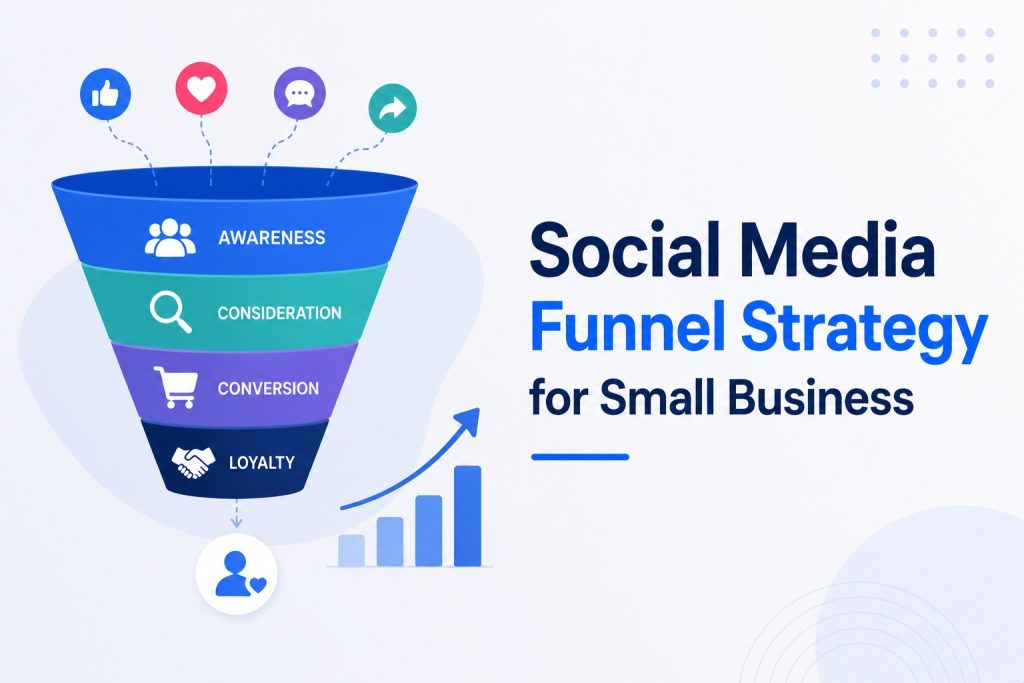
A social media funnel is a structured path that takes a stranger from first discovering your business to becoming a paying customer.
It borrows the classic marketing funnel shape: wide at the top, narrow at the bottom. Lots of people enter at the awareness stage. Fewer make it to consideration. Even fewer convert into customers.
The three core stages:
- Top of funnel (TOFU) – Strangers discovering your business for the first time
- Middle of funnel (MOFU) – People who know you exist and are evaluating whether you are right for them
- Bottom of funnel (BOFU) – People ready to buy, book, or take action
Without a funnel, every piece of content tries to do everything at once. A post asking for a sale gets shown to someone who has never heard of your business. A simple introduction post gets shown to someone who was already two minutes from booking.
Neither lands well. The funnel fixes that mismatch.
Why Small Businesses Need a Funnel, Not Just a Posting Schedule
Posting consistently is necessary. It is not sufficient on its own.
Without a funnel, content tends to cluster at one extreme.
- Either everything is promotional, which exhausts an audience that does not know you yet
- Or everything is generic brand awareness content, with no clear path toward a sale
- Either way, the business has activity but no system moving people toward becoming customers
A funnel gives every piece of content a job. It also gives you a way to diagnose what is actually broken when results stall.
If you have plenty of followers but no enquiries, that points to a missing middle or bottom of the funnel. If you have a strong offer but nobody finds you, that points to a missing top.
Mapping the Three Funnel Stages for Social Media
Each stage of the funnel needs a different type of content, a different tone, and a different goal.
Top of Funnel: Awareness
This stage is about getting in front of people who do not know your business exists yet.
The goal: maximize reach and make a strong first impression.
Content that works here:
- Educational posts that teach something useful with no sales pitch attached
- Entertaining or relatable content that earns shares and saves
- Behind-the-scenes content showing your team, process, or workspace
- Myth-busting posts that challenge a common assumption in your industry
- Short-form video designed purely to stop the scroll and earn a follow
What to avoid: Direct offers, pricing, or hard calls to action. Nobody at this stage is ready for that, and pushing it too early damages trust before it has a chance to form.
Middle of Funnel: Consideration
This stage is for people who already know you exist. They follow you, or they have seen your content more than once. They are deciding whether you are worth their time and money.
The goal: build trust and demonstrate you can actually solve their problem.
Content that works here:
- Case studies and client results with specific, believable outcomes
- Testimonials that include a real before-and-after, not just praise
- Deeper educational content that shows your process in detail
- FAQ content answering the objections people have before they buy
- Comparison content showing why your approach is different
What to avoid: Staying too surface-level. This is where depth matters. Someone in consideration wants proof, not just a friendly introduction.
Bottom of Funnel: Conversion
This stage is for people who are close to a decision. They have engaged with your content, maybe visited your profile or website, and just need the final push.
The goal: make it easy and obvious to take action right now.
Content that works here:
- Direct offers with a clear deadline or limited availability
- Strong calls to action: book now, DM to enquire, shop the link in bio
- Retargeting content to people who visited your website but did not convert
- Urgency-driven content tied to a specific promotion or limited spots
- Simple, friction-free booking or purchase paths
What to avoid: Being vague about the next step. At this stage, ambiguity costs conversions. Tell people exactly what to do.
For a deeper bank of specific post ideas across all three stages, this list of social media marketing ideas for small businesses covers 25 formats you can map directly onto each funnel stage.
Mapping Platforms to Funnel Stages
Different platforms naturally suit different stages of the funnel. Understanding this prevents wasted effort.
Top of funnel platforms:
- TikTok and Instagram Reels for the strongest organic discovery and reach
- YouTube Shorts for similar discovery value with longer-term searchability
- Pinterest for visually discoverable niches like home, food, and fashion
Middle of funnel platforms:
- Instagram feed posts and carousels for in-depth educational content
- LinkedIn for B2B trust-building through case studies and thought leadership
- Facebook for community-driven trust content and reviews
Bottom of funnel platforms:
- Instagram and Facebook Stories with direct links for urgency-driven offers
- Email retargeting paired with social ad retargeting for warm audiences
- WhatsApp Business or direct messages for closing the final conversation
This does not mean every platform is locked to one stage. A single platform can serve all three. What matters is being intentional about which stage a specific piece of content is built for.
Moving People From One Stage to the Next
A funnel only works if people actually move through it. This requires intentional bridges between stages, not just hoping someone naturally progresses.
From top to middle of funnel:
- End awareness content with a soft invitation: follow for more, save this for later, check the link in bio for a deeper resource
- Use Instagram Highlights or pinned posts to give curious new followers an easy next step
- Retarget people who engaged with top-of-funnel content using ads showing case studies or testimonials
From middle to bottom of funnel:
- Once someone has engaged with multiple pieces of consideration content, introduce a specific offer or limited-time incentive
- Use email capture (a free guide, checklist, or consultation) to move social engagement into a more direct channel
- Run retargeting ads specifically to website visitors who viewed a service page but did not book
From bottom of funnel to customer:
- Remove every possible point of friction: simplify the booking form, make pricing clear, respond to DMs quickly
- Use urgency authentically: real limited spots, real deadlines, not manufactured scarcity that erodes trust over time
- Follow up directly with anyone who started but did not complete a booking or purchase
A funnel without these bridges is just three disconnected piles of content. The bridges are what make it function as a system.
Using Paid Advertising to Strengthen Your Funnel
Organic content can build a complete funnel on its own, but paid advertising accelerates it significantly when layered in correctly.
Top of funnel paid strategy:
- Run awareness or reach campaigns to cold audiences matching your ideal customer profile
- Keep creative light and engaging, not sales-focused
- Budget: smaller spend here, since the goal is volume of impressions, not immediate conversion
Middle of funnel paid strategy:
- Retarget anyone who engaged with your top-of-funnel content (video views, profile visits, page likes)
- Show case studies, testimonials, and deeper educational content
- Budget: moderate spend, since this audience is smaller but more valuable
Bottom of funnel paid strategy:
- Retarget website visitors and people who started a booking or checkout but did not finish
- Show direct offers with clear urgency and a strong call to action
- Budget: this typically delivers the strongest return per dollar spent, since the audience is already warm
This layered approach is far more efficient than running one generic ad campaign to everyone at once. Each layer does a specific job, and the budget follows where the conversion potential is highest.
How to Measure Performance at Each Funnel Stage
A funnel without measurement is just a theory. You need to know whether people are actually moving through it.
Metrics for top of funnel:
- Reach and impressions
- New follower growth
- Video completion rate and watch time
- Profile visits from content
Metrics for middle of funnel:
- Saves and shares on educational and trust-building content
- Website link clicks
- Email sign-ups or lead magnet downloads
- DM enquiries asking about services
Metrics for bottom of funnel:
- Conversion rate on offers and promotions
- Cost per lead and cost per acquisition for paid campaigns
- Booking or checkout completion rate
- Revenue directly attributable to social media
Reviewing these numbers stage by stage tells you exactly where the funnel is leaking. If top-of-funnel reach is strong but middle-of-funnel saves and shares are low, your content is reaching people but not earning enough trust to move them forward.
For a complete breakdown of which specific metrics matter most and what good performance looks like, this guide on important social media KPIs for small businesses covers every stage in detail.
Common Funnel Mistakes Small Businesses Make
Even with a clear structure, certain mistakes show up repeatedly when small businesses build their first social media funnel.
- Skipping the middle entirely. Jumping straight from awareness content to direct offers, with no trust-building in between, leaves people unconvinced and uninterested in converting.
- Treating every platform the same. Posting identical content across every channel ignores the fact that different platforms naturally serve different funnel stages.
- No clear call to action at any stage. Even top-of-funnel content needs a soft next step. Without one, engaged viewers have nowhere to go.
- Running paid ads without funnel awareness. Sending cold traffic straight to a sales offer wastes budget. Cold audiences need awareness and trust content first.
- Never reviewing where people drop off. Without stage-by-stage measurement, it is impossible to know whether the funnel is actually working or just looks busy.
Many of these issues overlap with broader social media execution problems. A full breakdown of the most common mistakes small businesses make and how to fix each one is covered in this guide on social media mistakes small businesses make.
A Simple Example Funnel for a Small Business
Here is what this looks like in practice for a local fitness studio.
Top of funnel:
- Instagram Reels showing real workout moments and quick form tips
- TikTok content busting common fitness myths
- Goal: reach new people in the local area and earn follows
Middle of funnel:
- Instagram carousel posts featuring real client transformations
- A pinned Story Highlight with FAQs about pricing, schedule, and what to expect
- An email opt-in offering a free week trial in exchange for an email address
- Goal: build trust and move engaged followers into a direct contact channel
Bottom of funnel:
- A retargeting ad to website visitors offering a limited-time discounted first month
- A direct Instagram Story link to book a free consultation, with a clear deadline
- A follow-up DM to anyone who started the booking form but did not finish
- Goal: convert warm, engaged leads into paying members
This same structure works for almost any small business. The content changes. The stages and logic stay the same.
How a Funnel Connects to Your Broader Strategy
A social media funnel does not replace your overall strategy. It sits inside it.
Your strategy defines your positioning, your audience, and your content pillars. The funnel takes that foundation and organizes it into a system that actually moves people toward becoming customers.
If you have not yet built that broader strategy, this guide on how to create a social media strategy for small business covers positioning, audience, and content planning in full detail, which makes building an effective funnel on top of it far more straightforward.
Want the Funnel Built and Run for Your Business?
Designing a funnel is one part of the work. Creating the right content for each stage, running the retargeting ads, and tracking where people drop off is the part that takes ongoing time most small business owners do not have.
Our social media marketing for small business service builds and manages this entire system, so your content is always doing the right job at the right stage without you having to manage it day to day.
The Bottom Line
A social media funnel is not complicated. It is awareness content for strangers, trust content for people considering you, and clear offers for people ready to act.
The mistake most small businesses make is skipping straight to the offer. The fix is building the bridge in between.
Map your content to the right stage. Build the connections between stages. Measure where people drop off. That structure, applied consistently, turns social media from a guessing game into a system that reliably brings in customers.