
Most businesses treat social media like a guessing game. They post a few times a week, throw money at a random ad, reply to some comments, and then wonder why their follower count grows but their revenue doesn’t.
The issue isn’t effort. It’s the absence of a system.
That’s where the P.A.C.E. framework comes in. It’s one of the more practical approaches to social media marketing strategy right now — and most brands have never heard of it. If you’re tired of posting into the void and getting nothing back, this framework is worth understanding before you spend another dollar on content or ads.
What Is the P.A.C.E. Framework?
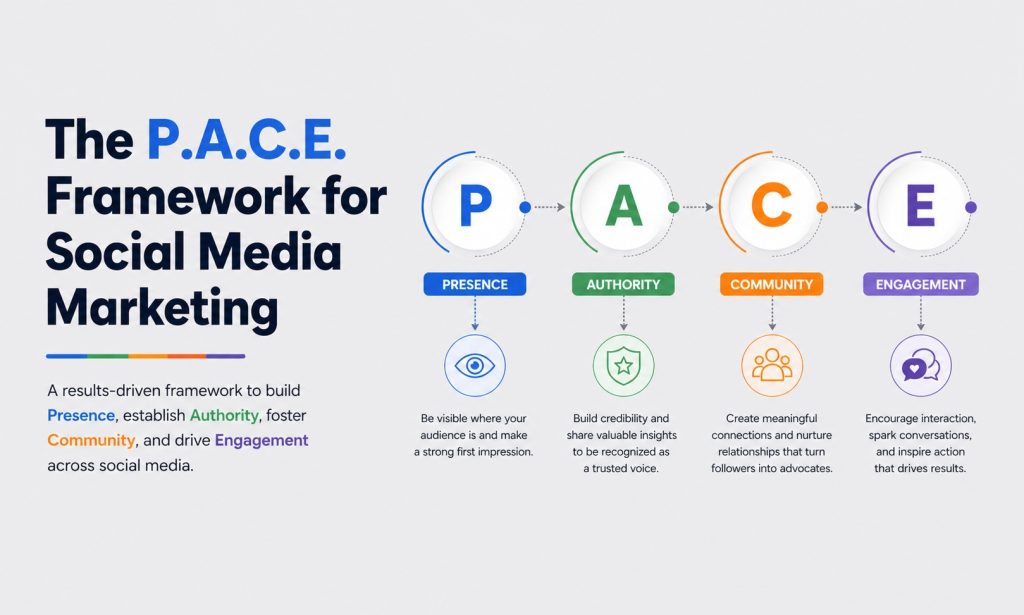
P.A.C.E. stands for Presence, Authority, Community, and Engagement. Each part has a specific job. Together, they create a system that moves someone from “never heard of you” to “ready to buy from you.”
It’s not a content calendar. It’s not a posting schedule. It’s a way of thinking about what your social media is actually supposed to do at each stage of the buying journey — and whether it’s doing it.
P — Presence: Be Somewhere Before You Try to Be Everywhere
Presence is about showing up where your buyers already are — not everywhere, just where it counts.
This is where a lot of brands waste time. They create accounts on LinkedIn, Instagram, TikTok, X, and Pinterest all at once, post inconsistently across all five, and get traction on none of them. The P.A.C.E. framework pushes back on that. Pick the platforms where your target audience actually spends time, and build a real presence there first.
A local home renovation company isn’t going to find homeowners on LinkedIn. They’re on Instagram and Pinterest, saving ideas for their next project. A B2B HR software company isn’t going to get clients from TikTok. Their buyers are on LinkedIn during work hours, reading posts about hiring, retention, and remote team management.
What building Presence looks like:
- Consistent branding across your chosen platforms — same logo, same tone, same handle where possible
- Posting regularly enough that your name becomes familiar (not necessarily viral, just recognized)
- Using platform-native formats — carousels on LinkedIn, Reels on Instagram, short-form video on TikTok if that’s where your audience is
- Geo-tagged posts and location-specific content if you serve a local market
The goal at this stage isn’t impressive reach numbers. It’s simple recognition. People buy from names they’ve seen before.
A — Authority: Give People a Reason to Trust You
Once people know you exist, the next job is giving them a reason to listen to you.
Authority on social media isn’t built by posting product photos or running “limited time offer” stories every other day. It’s built by consistently sharing things your audience finds genuinely useful — content they save, screenshot, or send to a colleague.
Think about accounts you personally follow. You probably follow them because they taught you something, showed you a perspective you hadn’t considered, or gave you information you could actually use. That’s the kind of authority you’re building here.
Content that builds authority fast:
- Specific how-to posts that solve one real problem (not “5 ways to improve your marketing” — try “here’s exactly why your Instagram reach dropped and what we changed to fix it”)
- Data-backed takes on industry trends, with actual sources cited
- Honest comparisons — including when your service isn’t the right fit for someone
- Behind-the-scenes content that shows your process, not just the polished result
That last point about honesty is underused. When a brand admits their product isn’t right for everyone, people trust them more, not less. It signals confidence.
One thing to avoid: generic educational content that covers topics so broadly it says nothing. Vague posts get scrolled past. Specific ones get saved.
Understanding how social media marketing helps businesses grow starts here — at the authority stage — because trust is what separates a brand people buy from versus one they just follow.
C — Community: Build Something People Want to Belong To
A following is a number. A community is a group of people who feel connected to each other through you.
This is where most social media strategies stall. Brands spend most of their energy reaching new people and almost nothing on the people who already follow them. That’s backwards. A follower who feels like they belong to something will refer you to peers. A follower who just sees your posts will keep scrolling.
Community isn’t built through content alone. It’s built through behavior:
- Responding to comments with actual sentences, not just emojis or one-word replies
- Asking questions that invite real answers — not “drop a 🔥 if you agree” but “what’s the biggest thing holding your business back on social right now?”
- Featuring your customers publicly — their results, their stories, their wins
- Creating spaces where your followers interact with each other, not just with you (LinkedIn newsletters, Facebook Groups, Instagram broadcast channels)
This stage is also where sales conversations start happening without you pushing for them. When someone feels like they’re part of a community you’ve built, they don’t need as much convincing. The trust is already there. And if you’ve ever wondered whether social media marketing actually increases sales, this is the stage where the answer becomes obvious — community members convert at significantly higher rates than cold followers because the relationship is real, not transactional.
E — Engagement: Turn Attention Into Something That Pays
Engagement in the P.A.C.E. framework isn’t likes and reach. It’s the deliberate move from “people watching your content” to “people doing something because of it.”
That something could be:
- Clicking through to a landing page or blog post
- Sending a DM to ask about your services
- Booking a call or requesting a quote
- Sharing your post with someone who needs to see it
This doesn’t happen by accident. Every piece of content you create should have a reason to exist beyond looking good on your feed. That means thinking about the next step before you hit post.
Engagement tactics that actually work:
- Soft CTAs in valuable posts — “If this helped, save it” outperforms “follow us for more tips” almost every time
- Story polls and question stickers — low effort for the audience, high signal for you about what they actually care about
- DM outreach to commenters — when someone engages with a post, a direct message offering something specific (a free audit, a relevant resource, a short answer to their question) converts far better than any ad
- Retargeting warm audiences — people who’ve already engaged with your content are the cheapest and most likely-to-convert segment you can run ads to
Engagement is also where your data starts to mean something. Not impressions and follower counts — those are vanity metrics. Watch your saves, link clicks, DM volume, and conversion rate on whatever action you’re driving toward.
Why This Framework Works When Random Posting Doesn’t
Most social media advice treats every post like it exists alone. Be consistent. Use hashtags. Add value. It’s not wrong — it’s just not a strategy.
The P.A.C.E. framework works because it maps directly to how people actually make buying decisions. They notice you (Presence), decide you seem credible (Authority), start to feel like you’re their people (Community), and then take action (Engagement). That’s the same path a customer walks whether they find you through organic content, paid ads, or a referral from a friend.
If your current social media strategy is missing any one of those four stages, there’s a gap. And that gap is exactly where potential customers disappear.
Where to Start With P.A.C.E.
You don’t need to build all four pillars at once — and trying to do it all immediately usually means doing none of it well.
Start by figuring out where the gap is. If nobody knows your brand exists in your target market, focus on Presence. If you have followers but no one engages, the problem is likely at the Authority or Community stage. If you have an engaged audience but no conversions, your Engagement tactics need attention.
Find the gap. Fix that first. Then build the next layer.
Social media marketing done right isn’t about posting more. It’s about posting with a structure that matches how your buyer thinks — at the right stage, on the right platform, with the right next step in mind. That’s what the P.A.C.E. framework gives you.