
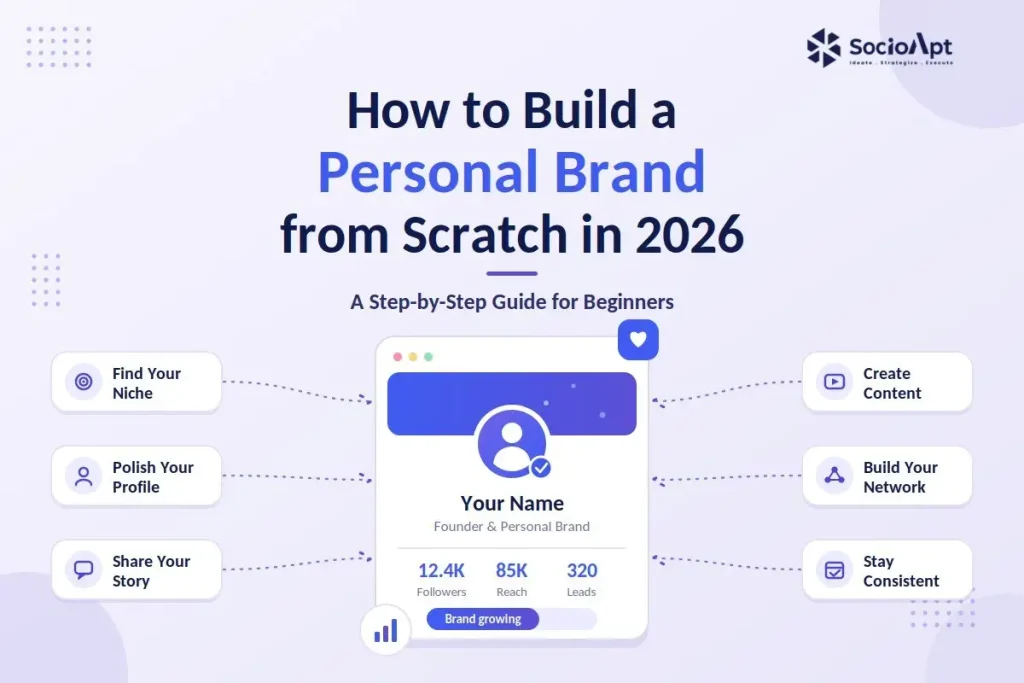
Before entering a room, people might get to know about your name. Before contacting you, the customer might be looking at your LinkedIn feed. An investor might research your career before meeting you. Sometimes, a simple Google search will influence opinion on your knowledge even without you saying a word.
That is why personal branding is important in today’s world. Personal branding is not about leaving a good impression on the Internet or turning everything about yourself. It is about shaping your skills and values in the eyes of people. No matter whether you are a founder of a startup, a freelancer or an employee your presentation influences your professional life.
The amazing part of such self promotion is that you do not have to have much experience or many followers. All you need to do is realise your uniqueness and figure out how to showcase it in an effective way.
What Does Building a Personal Brand Really Mean?
Personal branding or self branding can described as the image created by your behaviour and communications. This is due to the fact that personal branding includes your ability and knowledge in terms of professionalism. Like a marketing consultant can build a personal brand by sharing marketing tips in simple language that people can easily understand. Similarly, an entrepreneur can build a reputation by sharing ideas about understanding customer needs and running a business. Such are the ways in which their personal brands are built through the communication of their ideas and collaboration with other people.
Personal branding should never be confused with having a false image that catches attention from others. Personal branding involves the communication of yourself that adds value to you.
1. Understand What You Want to Be Known For
But first, before you begin developing your content and updating your profiles, you need to spend some time thinking about who exactly you would like to present yourself as. Without any particular direction, your content and area of expertise will be confused and unclear.
Try to think of the spheres where you feel comfortable and which problems you could solve. As well try to consider your experience gained through working.
Several questions may guide you to find the answer to the problem of direction:
- What skills do I possess?
- Which topics can I discuss with confidence?
- About what problems do people ask me for help?
- Who needs my experience?
- What are my professional goals?
2. Identify the Audience You Want to Reach
The concept of personal branding takes on another level of meaning if you are aware of whom you wish to reach. The followers of a startup founder will not share similar interests as the followers of a career coach and a digital marketer. You should think of the audience you wish to reach out to. The target audience might consist of potential clients, employers, investors, and other individuals from the same industry. Their requirements and the knowledge they possess prior to making a decision. Such as, if you give marketing services, then your audience may include entrepreneurs who wish to increase their online presence. Your content can solve their marketing problems and help them enhance the effectiveness of their campaigns. If you are aware of your target audience, then you will be able to create relevant content based on their queries rather than just posting content for the sake of it.
3. Build a Clear and Consistent Online Presence
Your online profiles shall always be the first point of reference when building your professional image. If anyone searches for you online, there must be clarity in terms of what you do and what your expertise is all about.
If LinkedIn is important for your professional objectives, then start from here. Analyse your headline and the about section of your LinkedIn profile and make sure that you have used simple language to state your expertise. Have a professional picture and also provide details about your profession.
Your online profile should be able to answer the following questions:
- What do you do?
- Whom do you help?
- Why is your expertise relevant?
You may also analyse your other public profiles and make sure that they too are a true reflection of your professional image. This does not necessarily mean that everything you write in each one of them must be similar. The identity that you build as a professional must remain consistent regardless of where you are found.
4. Create a Personal Brand Strategy for Your Content
Now that the directions have been determined and the target audience specified, it is time to think of the messages that will be delivered. A clear personal brand strategy helps you deliver your message with purpose instead of posting randomly.
- Share relevant knowledge related to your field: Owner of a startup can share knowledge and experience in business management, industry knowledge, his or her own experience, etc. If you are working in marketing, then you can share your experience of conducting marketing campaigns, learning about consumer behavior, etc.
- Use the right content format: Opinions and tips can be easily shared in form of LinkedIn posts; articles are better for discussing certain topics in detail. Videos will give you an opportunity to present yourself.
- Offer something valuable: Share your experience, mention mistakes that usually take place in your field and share your opinion about certain topics.
- Speak naturally and easily: It is not necessary to make all of your posts perfect.
5. Share Your Knowledge Instead of Only Promoting Yourself
One mistake in personal branding is the tendency to write about accomplishments in every post. Professional accomplishments are important, but a profile dedicated to services offered and personal successes might lack a good reason for others to interact with you. It is recommended to share what you know. Share the way you tackled certain issues, or lessons you learned from your work experience or your thoughts on particular issues concerning your business environment.
For example, instead of saying that you have worked as a digital marketer, it would be better to say why some websites get visitors and do not receive enquiries. This will give people a better idea of your approach to solving problems.
Lessons can be shared from cases when things went wrong for you. The idea of discussing a challenge and analyzing mistakes you made can be very beneficial.
6. Be Consistent Without Posting Every Day
Building a personal brand takes time and consistency helps people become familiar with your ideas. You do not need to publish posts or articles every day to maintain an active presence.
- Follow a posting schedule: Choose a routine that fits you and allows you to share content without feeling overwhelmed.
- Stay active between posts: Answer relevant questions, respond to queries and participate in discussions with professionals.
- Engage with professionals: Share your opinions on relevant topics and contribute to conversations. This helps people understand your perspective not just your content.
- Maintain consistent communication: Keep your topics and message match with your professional goals so your audience can recognise what your personal brand says.
- Focus on long term consistency: Choose a routine that you can follow for months rather than a plan that becomes difficult to maintain after a few weeks.
7. Build Relationships Along With Your Online Presence
The development of one’s personal brand is not limited to creating content. Personal brand is also formed as a result of networking. Get in touch with professionals in your field, and pay attention to what they do. Write meaningful comments that contribute to a discussion instead of just providing something generic. If somebody gives valuable information, use it for your benefit if it is applicable to your readers and give credit.
You can also attend industry events and get involved in professional communities to communicate with others and get some useful knowledge out of this communication. With time these contacts will bring some new opportunities and collaborations and most importantly, your reputation will benefit from them.
8. Review Your Progress and Improve Your Approach
Establishing personal brand requires time. There may be situations when it is hard to track the effect of your actions; some posts will not work. Try to take into account a wider view of things and don’t concentrate on likes and followers.
Try to determine what kind of content may help you to start a discussion. Are there any people who are interested in your activities? Note visits to your profile, queries related to your field of interest and demands for networking.
You may consult with your colleagues and customers about your qualities and skills. This way, you will learn if your personal brand creates the right image. Now you have an opportunity to use this information in order to change your tactics. You can keep researching the topic which makes useful discussion. Besides, if there is no enough description of your skills and experience at your profile, you may correct this problem.
Common Personal Branding Mistakes to Avoid
In developing an image it is necessary to take into account those actions that can affect your professional performance negatively. Founders face extra challenges on LinkedIn for that read our guide 10 personal branding mistakes founders make on LinkedIn
- Copying professionals: Take inspiration from professionals that you know and like but never forget your experience and uniqueness.
- Trying to impress everyone: Concentrate on your target audience associated with your aims.
- Congratulating yourself in each post: Instead of saying how great you are, tell about your knowledge and experience.
- Making statements without facts proving them: Your experience and achievements are good enough for you to be professional.
- Not paying attention to your profile: See if your Headline and About fit your current activities.
- Going too fast: It takes time to understand your opinions and abilities.
Personal Branding vs Self Promotion | What Is the Difference?
Personal branding and self promotion are often confused, but they have different purposes. Self promotion focuses on communicating your achievements and abilities, and personal branding involves building a consistent professional identity over time.
| Personal Branding | Self Promotion |
| Focus on building a long term professional reputation. | Focus on highlighting your achievements, skills and success. |
| Shares knowledge, experiences, opinions and expertise. | Highlights results, services and qualifications. |
| Builds trust through consistent communication and meaningful interactions. | Create awareness of your abilities and what you give. |
| Develops through your content, behaviour and relationships. | Often takes place when presenting work, applying for opportunities or promoting a service. |
| Helps people understand what you stand for and what they can expect from you. | Helps people recognise your strengths and achievements. |
Turn Your Personal Brand Into Long Term Professional Growth
- Identify your professional goals: You need to identify what you are planning to achieve by using your personal brand. It can be getting relevant queries from your clients for a consultant, while for the founder, it can be about making contacts with investors and business partners.
- Select your content accordingly: The topics need to be in alignment with your professional knowledge and needs. Your content will be able to help you move in the direction you want to go professionally.
- Work on developing relationships: Not every post will have something productive for you. Meaningful conversations and regular interaction will be helpful for people to get familiarized with you and trust your professional expertise.
- Connect with other professionals: Connect and engage yourself in conversations related to your field and share your professional knowledge.
- Update your personal brand: Roles and goals can change with time. Therefore your personal brand also needs to be updated with the changes.
The Bottom Line
The process of developing personal brands in 2026 will begin with the definition of the type of person you want to become known as and the target audience you are interested in. It is vital to know that it is not necessary to have a large number of fans or even an image of yourself on the Internet in order to start the process. Consistent sharing of valuable information will enable you to have an online presence that corresponds with your professional experience. If you want expert help with self branding, SocioApt can build your personal brand with you. Our personal branding services help founders, consultants and professionals improve their positioning, create content and grow their authority.
Frequently Asked Questions
1. Why Should You Select SocioApt For Your Personal Branding?
Personal branding requires a lot of time, especially when you have no clue what content to post. SocioApt makes sure that founders and professionals alike can showcase their ideas and expertise while reaching the right target audience. It’s all about making the right impression and ensuring that people know who you are.
2. Is Personal Branding Useful For Business Owners To Gain More Leads?
Yes, personal branding can be helpful for business owners to generate leads as well. When people get exposed to your expertise and knowledge on an everyday basis they get a clearer picture of what you can offer.
3. When you should hire a Personal Branding Agency?
The cases when you need to collaborate with a personal branding agency include:
- When you find it hard to create and develop content.
- When it is hard to talk about your skills.
- When you find it hard to be active on various social media channels.
4. What Are the Best Platforms for Personal Branding?
There is no straight answer to this as everything comes down to what kind of work you do and what kind of audience you have in mind. LinkedIn is the best platform for founders and professionals wishing to share industry knowledge and network. Instagram is perfect for those who want to showcase their work.
5. How Can One Tell if it is doing progress in creating personal brand?
To keep a check on the progress take note of the reaction of the people towards your posts. Does it interest people enough to comment, share and invite you to collaborate with them or is there a chance that some people might even seek your advice or information? In this manner, you will know about the requirements of your target audience.
6. Can One Build a Personal Brand Being at the Beginning of Their Career?
Yes, you can launch your brand despite the fact that your career is just started. Talk about things that you are studying, speak on interesting topics and discuss things with experts. The experience is irrelevant here because one does not have to be an expert yet to start something like that.