
Most dental practices are sitting on a goldmine they never use.
They have years of real patient cases. A deep understanding of the fears people have about dental visits. Answers to questions patients ask every single week. And none of it is being used to bring in new patients.
Instead, they run ads. The ads stop, the phone goes quiet.
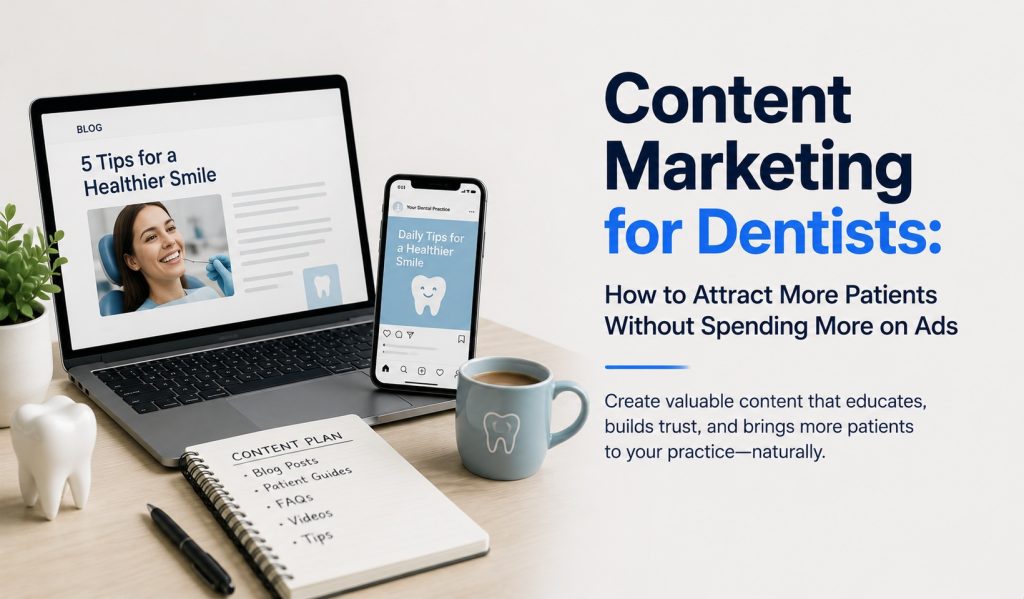
Content marketing for dentists works differently. It builds an asset that keeps bringing patients to your door long after you created it. A blog post, a YouTube video, an Instagram reel, an email sequence. These things work while you are treating patients, on weekends, and years after you first published them.
This guide covers every channel that makes dental content marketing work: social media, video, email, written content, and how they all connect into one system.
What Is Content Marketing for Dentists?
Content marketing for dentists means creating helpful, educational content across multiple channels that answers the questions your potential patients are already searching for, scrolling past, or clicking on.
It includes:
- Blog posts and procedure guides on your website
- Instagram, Facebook, and TikTok content
- YouTube and short-form video (Reels, Shorts)
- Email newsletters to existing and prospective patients
- Before and after case studies
- Patient education content and FAQs
- Google Business Profile posts
It is not advertising. Ads interrupt people. Content meets them at the moment they are already looking, scrolling, or curious.
Here is the difference in real life. Someone scrolls Instagram and sees a short video from a local dentist showing exactly what a veneer procedure looks like step by step. They have been self-conscious about their smile for years but never felt ready. That video makes the process feel real and less scary. They follow the account. Three weeks later they book a consultation.
No paid ad. No interruption. Just the right content reaching the right person at the right time.
Why Most Dental Practices Get Content Marketing Wrong
Before getting into the strategy, here are the most common mistakes dental practices make. Most are making at least two of them.
Writing for other dentists, not patients
Nobody searches “dental caries management protocol.” They search “how to stop a cavity from getting worse.” Your content needs to speak the language your patients use when they are scared and looking for answers, not the language you use in a clinical setting.
Treating content marketing as just blogging
Blogging is one piece. Patients are on Instagram watching Reels. They are on YouTube researching procedures before they book. They are opening emails from practices they already trust. A strategy that only covers blog posts misses most of where your patients actually spend time.
Talking about procedures instead of problems
Your patient is not searching for “veneers.” They are searching for “how do I fix a gap in my front teeth” or “why are my teeth so yellow even though I brush every day.” Build content around the problems your patients have and the right people find you.
Posting on social media without a real strategy
Posting a stock photo of a toothbrush with a generic caption about “good oral hygiene” does not build trust or bring in patients. Social media for dentists works when it shows real people, real results, real personality, and real expertise. Generic content gets ignored.
Ignoring existing patients in their content
Most dental content marketing focuses entirely on attracting new patients. But existing patients who trust you are your best source of referrals, repeat bookings, and reviews. Content that serves them between visits is one of the most underused growth levers a practice has.
Social Media Content Marketing for Dentists
Social media is where your future patients are spending two to four hours a day. The question is not whether you should be there. It is what to post that actually makes them stop, engage, and eventually book.
What Works on Instagram and Facebook
Instagram and Facebook are visual platforms. The content that performs best shows real things: real patients, real results, real moments inside your practice.
Content types that consistently perform:
- Before and after photos – With patient consent, these are the highest-engagement posts a dental practice can create. A smile transformation gets shared, saved, and sent to friends more than any other post type.
- Short educational videos – “What actually happens during a root canal” filmed by your actual dentist in under 60 seconds builds more trust than a paragraph of copy.
- Meet the team posts – Patients choose dentists they feel comfortable with. Showing the faces, personalities, and stories behind your practice makes people feel safe before they ever walk in.
- Patient testimonial clips – A 30-second video of a real patient talking about their experience is more persuasive than any marketing copy you will ever write.
- Myth-busting posts – “5 things people believe about teeth whitening that are not true” performs well because it creates curiosity and positions you as the credible source.
- Day-in-the-practice content – Short clips showing what a normal appointment looks like reduce anxiety for people who have been avoiding the dentist out of fear.
What to stop posting:
- Stock photos of teeth and toothbrushes
- Generic “happy national dental health month” posts
- Content that could belong to any dental practice anywhere
Your social media should feel like it could only belong to your practice.
What Works on TikTok
TikTok is where dentists have built massive followings and real patient bases by doing one thing: being genuinely useful and human on camera.
The best-performing dental TikTok content tends to be:
- Short procedure explainers filmed in the chair or operatory
- Reactions to patient questions sent in via comments
- “Things your dentist notices that you do not mention” style videos
- Honest myth-busting about dental products and procedures
- Real transformation reveals with patient permission
TikTok rewards authenticity and consistency over production quality. A dentist filming themselves on an iPhone answering “is it actually bad to rinse after brushing?” will outperform a polished promotional video every time.
Even if you are not targeting a younger audience, TikTok videos get repurposed as Instagram Reels, YouTube Shorts, and Facebook videos. One piece of video content becomes four.
How Often to Post on Social Media
Consistency matters more than frequency. Here is a realistic posting schedule that works:
- Instagram: 4 to 5 times per week (a mix of Reels, carousels, and single image posts)
- Facebook: 3 to 4 times per week (slightly longer captions work well here)
- TikTok: 3 to 5 times per week if you are starting out on video
- Google Business Profile: 1 to 2 times per week linking to content or sharing offers
Batch your content creation. Set aside two to three hours one day a week to create and schedule everything. It is far more efficient than trying to think of something to post every morning.
Video Content Marketing for Dentists
Video is the single most powerful format for dental content marketing and the most underused by dental practices.
Here is why it works so well for dentists specifically. The biggest barrier stopping people from booking a dental appointment is not cost, it is fear and unfamiliarity. Video removes both. When someone has watched your dentist explain a root canal in a calm, clear, friendly way before they ever set foot in your practice, they arrive with less anxiety and more trust already built.
Types of Video That Bring In Patients
Procedure explainer videos
Pick your most common procedures and film a short, patient-friendly explainer for each one. Keep them between 90 seconds and 3 minutes. Cover what the procedure involves, what to expect, how long it takes, and whether it hurts. Answer the questions people are too anxious to ask at the appointment.
Good examples:
- “What actually happens during a tooth extraction”
- “Invisalign: what the first week really feels like”
- “Is a root canal as bad as people say?”
Patient journey videos
Follow a patient (with their consent) from consultation through treatment to final result. These are the most trusted form of social proof a dental practice can create. They are not testimonials. They are stories, and stories convert.
Meet the dentist and team videos
A 2-minute video where your dentist talks directly to camera about why they chose dentistry, what they care about in patient care, and what makes your practice different does more for conversion than any written bio ever will.
FAQ videos
Take the most common questions patients ask at appointments and answer them on camera. Post one a week. These rank on YouTube, get shared on social media, and can be embedded on your website alongside the written answer.
Where to Publish Video
- YouTube as the primary home for longer content (2 to 5 minutes)
- Instagram Reels and TikTok for shorter clips (under 90 seconds)
- Your website service pages (a video on your implants page keeps visitors on the page longer and builds trust)
- Your Google Business Profile (videos on your GMB listing improve local visibility)
Email Content Marketing for Dentists
Email is the most overlooked channel in dental content marketing and one of the highest-return ones.
Your existing patient list is full of people who already trust you. They have been in your chair. They know your team. They have experienced your care. An email newsletter keeps that relationship warm between visits and turns your most satisfied patients into a referral engine.
What to Send and When
Monthly newsletter
One email a month to your existing patient list is enough to stay top of mind. Keep it simple:
- One piece of useful dental health information tied to your latest blog post or video
- A spotlight on a procedure or service (not a hard sell, just an educational mention)
- A patient story or testimonial with their permission
- A gentle reminder about scheduling if they are overdue for a checkup
Post-appointment follow-up sequence
After a patient visits, send a short sequence over the following two weeks:
- Day 1: Thank you email with aftercare instructions relevant to their treatment
- Day 5: Educational email related to their procedure or their next step
- Day 14: Soft reminder about booking their next appointment or a related service
This sequence does not feel like marketing. It feels like good patient care. And it keeps your practice in front of them at the exact moment when booking a follow-up appointment is most logical.
Reactivation emails
Patients who have not visited in 12 months or more are one of the most valuable audiences you have. A simple, personal-feeling email saying “we noticed it has been a while” with an easy booking link reactivates a meaningful percentage of lapsed patients every time it is sent.
What Makes Dental Emails Actually Get Opened
The subject line and the preview text are everything. Most dental practice emails get ignored because they read like promotional flyers.
Instead of: “Book Your Appointment Today”
Try: “The one thing most patients forget to ask at their checkup”
Instead of: “Spring Dental Promotion”
Try: “We just updated our whitening process and the results are different”
Write subject lines that create enough curiosity that opening the email feels worth it.
Written Content Marketing for Dentists: Beyond Just Blogging
Blog posts are important, but written content for dental practices goes much further than a website blog.
Types of Written Content That Work
Procedure landing pages
Each service your practice offers should have its own dedicated page that goes beyond a paragraph of description. A strong procedure page covers:
- What the procedure involves in plain language
- Who it is right for
- What to expect before, during, and after
- How much it costs (or a realistic range)
- Common concerns and honest answers
- Real patient results
These pages rank well in search and convert visitors into bookings better than any other page type on your website.
Patient guides and downloadable resources
A downloadable “What to expect from your Invisalign journey” guide or a “Dental implant checklist: questions to ask before you decide” positions your practice as a genuinely helpful resource, not just a service provider. These also build your email list when people exchange their email address to download them.
Before and after case studies
A written case study with photos covers the patient’s original situation, the problem they came in with, the treatment recommended, the process, and the outcome. These are among the most persuasive pieces of content a dental practice can publish because they show real evidence, not claims.
Community and local content
Content tied to your local area strengthens your visibility for patients searching in your specific city or neighborhood. This includes:
- Local area guides mentioning your practice
- Posts about community involvement or local sponsorships
- Location-specific procedure pages (“dental implants in [City]”)
For a broader look at how digital marketing channels connect into a full patient acquisition system, this guide on digital marketing strategy for dentists is worth reading alongside this one.
How All of This Connects Into One System
The most effective dental content marketing does not treat each channel as separate. Everything feeds everything else.
Here is how one piece of content can work across every channel:
- You film a 3-minute YouTube video answering “is Invisalign worth it for adults”
- You cut a 60-second version for Instagram Reels and TikTok
- You write a blog post on the same topic using the same talking points
- You send an email to your list linking to both the video and the blog post
- You post the short clip to Facebook and your Google Business Profile
- The blog post links to your Invisalign service page
- The service page has a booking button
One idea. Seven touchpoints. One patient who has now seen your practice on three different platforms, read your answer, watched your face, and feels ready to book.
That is what a real dental content marketing system looks like.
For a full picture of what dental marketing looks like beyond content, including reputation management, paid ads, and local SEO, this breakdown of dental marketing strategies covers everything in one place.
And if you would rather have a team build and run this system for you, our digital marketing services for dentists are built specifically for practices that want consistent patient growth without managing all of this themselves.
The Bottom Line
Content marketing for dentists is not just blogging. It is showing up where your patients already are: on Instagram at 9pm, on YouTube researching a procedure, in their email inbox on a Tuesday morning.
Every useful video you post, every honest email you send, every social media post that shows the real human side of your practice is a door into your world. Build enough of those doors, keep them open consistently, and patients start finding you instead of you chasing them.
Frequently Asked Questions:
1. What is content marketing for dentists and how is it different from regular advertising?
Content marketing for dentists means creating helpful, educational content across multiple channels that answers the questions and concerns your potential patients already have. Ads interrupt people. Content meets them when they are already looking. An ad stops working the moment you stop paying for it. A well-made YouTube video or a strong blog post keeps bringing in patients for years after you created it once.
2. How long does it take for dental content marketing to show results?
It depends on the channel. Social media content can generate engagement and inquiries within days if it resonates. Email to your existing list works almost immediately. Written content and SEO take longer, typically 3 to 6 months for search rankings to improve and 6 to 12 months for consistent organic traffic growth. The practices that stay consistent through that period end up with an asset that keeps paying off without ongoing ad spend.
3. What social media platforms should dentists focus on?
Instagram and Facebook are the most practical starting points for most dental practices because the audience demographics match well and the content formats (photos, short videos, carousels) work naturally for dental topics. TikTok is worth adding if you are comfortable on camera. YouTube is worth the investment if you can commit to regular video. Start with one or two platforms and do them well before adding more.
4. What types of video content work best for dental practices?
The best-performing video types for dentists are procedure explainers (showing what a treatment actually involves), patient journey videos (from consultation to final result with consent), meet the team videos, and FAQ-style videos answering common patient questions. Short-form video (under 90 seconds) works best on Instagram and TikTok. Longer explainers (2 to 5 minutes) perform better on YouTube and embedded on your website.
5. How does email marketing fit into a dental content strategy?
Email is one of the highest-return channels in dental content marketing because it reaches people who already trust you: your existing patients. A monthly newsletter keeps your practice top of mind between visits. Post-appointment follow-up sequences improve retention and next-visit bookings. Reactivation campaigns bring back lapsed patients. None of this requires heavy selling. It just requires showing up consistently with something useful.
6. Do I need to be on every social media platform?
No. It is far better to show up consistently on two platforms than to post sporadically across five. Pick the platforms where your target patients actually spend time, commit to a realistic posting schedule, and build real presence there before expanding. Most dental practices do well starting with Instagram and Facebook. Adding TikTok or YouTube comes once the foundation is in place.
7. How often should a dental practice post on social media?
A realistic and effective schedule is 4 to 5 posts per week on Instagram, 3 to 4 on Facebook, and 1 to 2 on Google Business Profile. Batch your content creation into one session per week rather than trying to post in real time every day. Consistency over months matters far more than posting frequency in any single week.
8. What written content should a dental practice prioritize beyond blog posts?
Beyond blog posts, the highest-value written content for dental practices includes dedicated service or procedure pages that go deep on each treatment, before and after case studies with real patient results, downloadable patient guides that build trust and grow your email list, and local area content that strengthens your visibility for patients searching in your specific city or neighborhood.
9. Can content marketing help with patient retention as well as new patient acquisition?
Yes, and this is one of the most underused advantages. Email newsletters keep existing patients engaged between visits. Educational post-appointment content reinforces their trust in the treatment decisions they made. Social media content that shows the real people behind your practice builds a community feeling that makes patients less likely to switch. Practices with strong content programs consistently see higher reactivation rates and more word-of-mouth referrals.
10. How do all these content channels work together for a dental practice?
The most effective dental content marketing treats every channel as part of one connected system. A YouTube video gets cut into a short Reel for Instagram. A blog post becomes five social media posts. An email links to both. Each piece of content points toward your service pages or booking page. When a potential patient encounters your practice on three or four different channels before they book, they arrive already familiar with you, already trusting you, and already sold on why you are the right choice.