
Small businesses have always had to compete against bigger budgets, bigger teams, and bigger brand names.
Social media changed that equation.
For the first time, a two-person bakery can reach 50,000 people in their city without buying a billboard. A solo consultant can build more trust and credibility than a firm ten times their size. A local gym can have a more engaged, loyal community than a national chain with a marketing department.
That is not an accident. Social media levels the playing field in ways that no other marketing channel has before. But only when small businesses understand what it actually does for them and use it with a real strategy behind it.
Here are the concrete benefits of social media marketing for small businesses, and what each one actually looks like in practice.
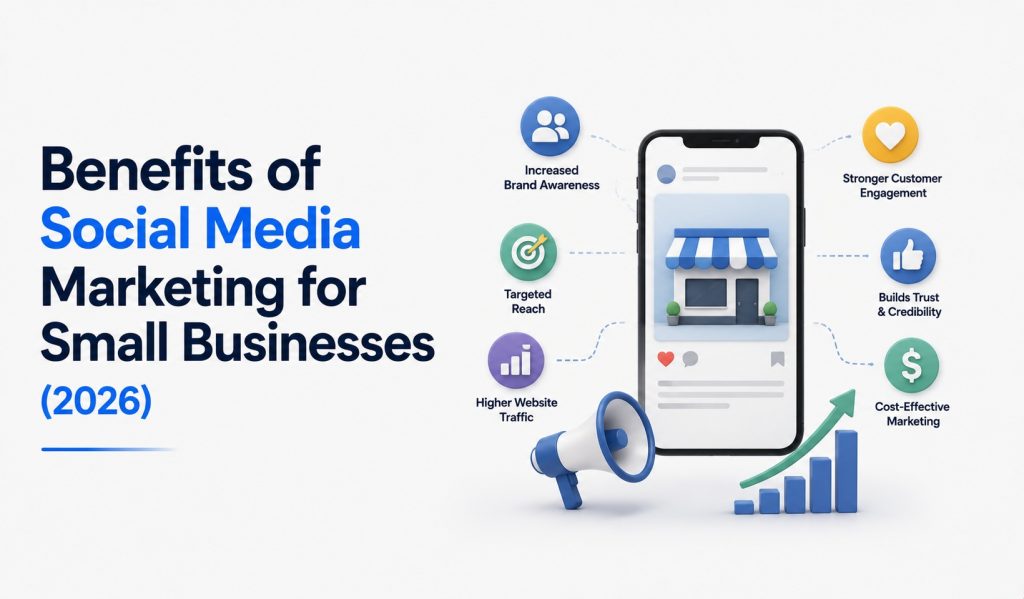
10 Benefits of Social Media Marketing for Small Businesses
1. It Builds Brand Awareness Without a Big Budget
The most basic benefit of social media marketing is also the most powerful one for small businesses: it puts you in front of people who do not know you exist yet, at a fraction of what traditional advertising costs.
A consistent presence on Instagram, Facebook, TikTok, or LinkedIn means your business shows up in feeds, search results, and recommendations regularly. Over time, people start recognizing your name. They see your posts enough times that when they need what you offer, you are the first business they think of.
This is called top-of-mind awareness, and it used to require either a massive ad budget or years of word-of-mouth. Social media compresses that timeline dramatically.
What this looks like for small businesses:
- A local restaurant posts daily food content on Instagram. Within six months, people who have never visited start tagging friends and saying “we need to go here.”
- A freelance photographer posts their work consistently on LinkedIn and Instagram. Potential clients find them without any outreach because the content does the finding for them.
- A small e-commerce brand posts product content on TikTok. One video reaches 80,000 people. Their website traffic triples in a week.
None of these required a large ad spend. They required showing up consistently with content worth watching.
2. It Is the Most Cost-Effective Marketing Channel Available
Traditional marketing is expensive. A print ad in a local magazine, a radio spot, a direct mail campaign, a trade show booth. These cost thousands of dollars for limited, often unmeasurable reach.
Social media marketing changes the cost structure entirely for small businesses.
The cost comparison:
- Creating and posting organic content on Instagram, Facebook, LinkedIn, or TikTok costs nothing except time
- A Facebook or Instagram ad can reach thousands of targeted local customers for as little as five to ten dollars a day
- Boosting a well-performing post to a wider audience can be done for twenty to fifty dollars and reach more people than a local newspaper ad costing hundreds
- Tools like Canva make professional-quality graphics accessible with no design budget
Small businesses that commit to organic content marketing and supplement it with small, targeted paid ad campaigns consistently get better returns than businesses spending the same budget on print, radio, or outdoor advertising.
The reason is targeting. When you run a Facebook ad, you can choose exactly who sees it: people within five miles of your location, within a specific age range, with specific interests, who have visited your website before. Traditional advertising cannot do that.
3. It Lets You Compete Directly With Bigger Businesses
This is one of the most underappreciated advantages of social media marketing for small businesses.
On social media, your content competes with every other piece of content in the feed regardless of how big or small the brand behind it is. A post from a local coffee shop can outperform a post from a national coffee chain if it is more interesting, more specific, more real, and more relevant to the people seeing it.
Big businesses often struggle with social media because they have too many layers of approval, too much brand consistency to maintain, and too little willingness to be genuinely human and spontaneous. Small businesses can do all of those things immediately.
Where small businesses win against larger competitors:
- Speed – You can respond to a trend, a comment, or a customer question within minutes. A large brand might take days to get internal approval.
- Authenticity – Showing the real face of your business, the behind-the-scenes, the owner’s personality, the team’s humor, builds the kind of trust that polished corporate content cannot.
- Local relevance – Content tied to your specific neighborhood, community events, and local culture resonates deeply with a local audience. A national brand cannot replicate that.
- Relationships – When someone comments on your post, you can respond personally and specifically. That kind of interaction builds loyalty that no big-budget campaign can buy.
4. It Drives Real, Measurable Website Traffic
Every piece of social media content is an opportunity to send people to your website, your booking page, your product listings, or your contact form.
Done consistently, social media becomes one of the most reliable sources of referral traffic for small businesses. And unlike traffic from ads that stops the moment you stop paying, organic social traffic compounds over time as your following and content library grow.
How small businesses drive traffic from social media:
- Adding a clear link in bio or profile that points to the most relevant page (a booking page, a shop, a lead magnet)
- Including calls to action in posts that direct people to a specific page for more information
- Instagram Stories with link stickers sending followers directly to a product or article
- LinkedIn posts that reference a piece of content with a “full article in the comments” approach that drives profile visits and link clicks
- TikTok and Reels that create enough curiosity that viewers actively seek out the website
The quality of this traffic also tends to be higher than cold traffic from ads. Someone who has been following your account for weeks and then clicks through to your website already trusts you. They convert at a higher rate than someone who saw a single ad.
5. It Builds Customer Trust and Social Proof
People do not buy from businesses they do not trust. And before they trust you, they look for evidence that other people already do.
Social media is where that evidence lives.
The trust signals that social media provides:
- Follower counts and post engagement show that real people follow and interact with your business
- Customer reviews and testimonials shared as posts or Stories
- User-generated content, real customers posting about your product or service without being asked
- Comments from satisfied customers visible publicly on your posts
- Response rate and tone when people ask questions or raise concerns publicly
A small business with an active, engaged social media presence looks more credible than one with no presence at all, even if the business with no presence is objectively better. That is the reality of how people evaluate businesses today before they spend money.
Reviews on platforms like Yelp and Google matter. But a social media profile that shows consistent activity, real customer interactions, and genuine expertise is often the deciding factor when someone is choosing between two similar businesses.
6. It Creates Direct, Two-Way Communication With Customers
Every other marketing channel is a one-way broadcast. You put out an ad, a flyer, a TV spot. People see it. The conversation ends there.
Social media is a conversation. And for small businesses, that changes everything.
What two-way communication on social media makes possible:
- Customers can ask questions about products, hours, pricing, or availability and get real answers in real time
- You can gather direct feedback about what customers love and what they want improved
- You can run polls and questions to understand what your audience actually wants before you create it
- Complaints get addressed publicly and quickly, which shows everyone watching how you handle problems
- Real relationships form with regular customers who comment, share, and engage consistently
This kind of direct access to your customers is something that businesses used to pay market research firms thousands of dollars to get. Social media gives it to you for free, every day.
7. It Supports Customer Retention and Loyalty
Attracting a new customer costs five times more than keeping an existing one. Social media is one of the most effective tools small businesses have for keeping existing customers engaged, coming back, and bringing others with them.
How social media builds customer loyalty for small businesses:
- Regular content keeps your business top of mind between purchases or visits
- Exclusive social-only offers, early access announcements, or behind-the-scenes previews make followers feel valued
- Acknowledging and celebrating loyal customers publicly (with their permission) deepens the relationship
- Consistent posting of useful content positions you as the trusted go-to source in your category, not just a transactional option
- Community-building content (polls, Q&As, shared interests) creates a sense of belonging around your brand
Customers who follow a small business on social media and engage with its content regularly are significantly more likely to return, refer friends, and leave positive reviews than those who do not. That is not a coincidence. It is because the social media relationship keeps the connection active.
To understand how these benefits translate into measurable numbers and business results, this breakdown of how to measure the ROI of social media marketing covers the metrics that matter most.
8. It Generates Leads and Sales Directly
Social media is not just a brand awareness channel. Done right, it is a direct lead generation and sales engine for small businesses.
The ways social media generates leads and sales:
- Direct messages – Potential customers message your business directly to ask about pricing, availability, or bookings. This is one of the highest-converting lead sources for local service businesses.
- Social commerce – Instagram Shopping, Facebook Shops, TikTok Shop, and Pinterest Shopping allow customers to purchase directly through the platform without leaving the app.
- Link in bio and Stories links – Sending followers directly to a booking page, product page, or lead form.
- Lead generation ads – Facebook and Instagram lead gen ads collect contact information directly within the platform without requiring a website visit.
- Limited-time offers – A flash sale or exclusive discount posted on Stories or as a time-sensitive post creates urgency that drives immediate purchases.
A small clothing boutique using Instagram Shopping, posting styling content regularly, and running small targeted ad campaigns to local audiences can generate consistent daily sales from social media alone. That is a real and common outcome for small product businesses that treat social media as a sales channel, not just a display window.
9. It Gives You Audience Insights You Cannot Get Anywhere Else
Every social media platform gives you free data about your audience that would have cost significant money to gather through traditional market research.
What social media analytics tells you:
- Which content your audience engages with most (so you can make more of it)
- When your followers are most active online (so you post at the right time)
- The age, location, and gender breakdown of your audience (so you know if you are reaching the right people)
- Which posts drive the most website clicks, profile visits, or saves
- How your follower count grows or shrinks over time and what drives each change
Tools like Meta Business Suite, TikTok Analytics, LinkedIn Analytics, and third-party tools like Hootsuite and Sprout Social make this data accessible to businesses of any size.
Small businesses that pay attention to these insights and adjust their content based on what they learn grow their presence far faster than those that post without looking at the results.
10. It Helps With Local SEO and Online Discoverability
Social media presence and activity contribute to how easily your business is found online, both on social platforms and in Google search results.
How social media supports discoverability:
- An active Instagram or Facebook profile with consistent location tags and local keywords helps your business appear in platform searches when people look for businesses in your area
- Google indexes social media profiles, meaning a well-optimized LinkedIn or Facebook page can appear in Google search results for your business name or category
- Consistent name, address, and phone number information across your social profiles and your Google Business Profile strengthens local SEO signals
- Social media activity drives website traffic, and increased traffic sends positive signals to Google about your website’s relevance and authority
- Customer reviews and check-ins on Facebook and Instagram act as social proof that Google factors into local ranking decisions
For small businesses that depend on local customers, this connection between social media and local search visibility is one of the most practical and underused benefits available.
How to Start Getting These Benefits
Knowing the benefits of social media marketing is one thing. Actually building a system that delivers them requires a clear strategy, consistent execution, and the right content for your specific audience and goals.
The businesses that see the most from social media are not necessarily the ones with the biggest following. They are the ones who know exactly who they are talking to, show up consistently with content that serves that audience, and treat social media as a genuine two-way channel rather than a billboard.
If you are a small business looking to build that kind of presence without figuring it all out alone, working with a team that specializes in social media marketing for small business means you get the strategy, content, and execution in place without it consuming all of your time.
The Bottom Line
Social media marketing gives small businesses something that used to be impossible: the ability to build a brand, attract customers, earn trust, generate leads, and compete with larger players without needing a large budget or a marketing department.
The benefits are real. The results are measurable. And the cost of not showing up is getting higher every year as more businesses do.
Start with one or two platforms. Show up consistently. Create content that actually serves your audience. And treat every comment, message, and interaction as an opportunity to build a relationship.
That is how small businesses grow on social media. Not by going viral once, but by showing up well, repeatedly, over time.