
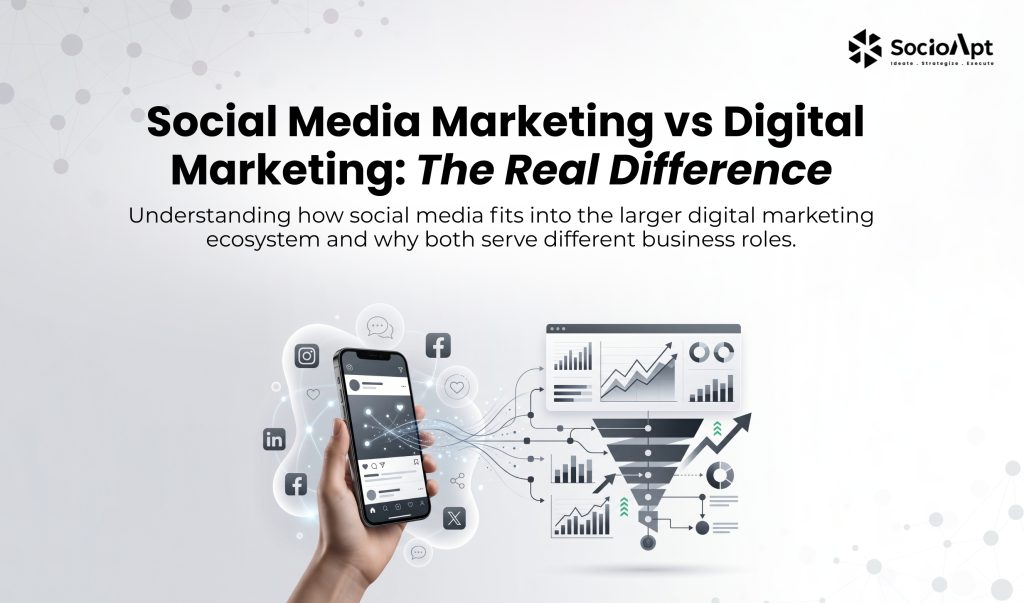
What is social media marketing and how does it differ from digital marketing?
The answer to that question can be confusing for a lot of businesses that are using digital marketing as a means of growth; therefore, a lot of businesses find themselves asking this question in strategy meetings.
The confusion is very reasonable because social media marketing has been discussed by a lot of companies as the only area of Digital Marketing. In fact, Social Media Marketing is only one piece of a much larger Digital Ecosystem. Failure to understand this distinction can create a lot of frustration, wasted budgets and misalignment of performance metrics for many businesses.
This article explains whether social media marketing and digital marketing are the same, clarifies the difference between digital marketing and social media marketing, and uses industry data to explain how both function in modern business strategy.
Understanding Digital Marketing
Digital marketing refers to all marketing activities carried out through digital channels. It is the overarching framework that includes every online touchpoint a business uses to attract, engage, convert, and retain customers.
This includes search engine optimisation (SEO), paid search advertising, display ads, email marketing, content marketing, social media marketing, marketing automation, and analytics.
Digital marketing is primarily outcome-driven. It focuses on traffic acquisition, lead generation, conversions, and measurable return on investment. Its success is usually evaluated through metrics such as cost per lead, conversion rate, and revenue attribution.
In simple terms, digital marketing is the complete online growth system for a business.
What Is Social Media Marketing?
Social media marketing is a specialised branch of digital marketing that focuses exclusively on social platforms such as LinkedIn, Instagram, Facebook, X (Twitter), TikTok, and similar networks.
It involves creating platform-specific content, engaging with audiences, managing communities, running paid social campaigns, and monitoring engagement and sentiment.
According to Sprout Social, over 90% of marketers say social media has increased exposure for their businesses, and a majority also report improvements in brand loyalty and trust.
Unlike other digital channels, social media marketing is inherently interactive. It enables two-way communication and plays a critical role in shaping brand perception rather than focusing solely on immediate conversions.
Social Media Marketing vs Digital Marketing: The Core Difference
SMM involves building relationships between businesses and customers through Social Media channels, while Digital Marketing includes all Digital Marketing Techniques (including SMM).
Digital Marketing gives businesses a fundamental understanding of the overall digital marketing environment and a means for businesses to generate interest in their products or services and respond to the demand in several different geographical areas for each of the various types of Digital Media (i.e. Search and Performance Advertising) and all of the methods associated with those types of Digital Media (e.g., websites, mobile apps, etc.).
Through the functions of SMM, businesses are able to impact how customers view brands, develop familiarity with brands, and create trust in businesses through the development of relationships with their customers over time.
Are Social Media Marketing and Digital Marketing the Same?
A common question business ask is: are social media marketing and digital marketing same?
The answer is no.
Frequently, businesses treat social media marketing as a form of digital marketing; however, digital marketing includes various other forms (search engine marketing, email marketing, etc.), which operate as standalone channels, separate from social media. The majority of businesses expect to see immediate return on investment from their social media marketing efforts. Unfortunately, many do not understand that the primary role of social media marketing is not direct sales.
For example, paid search advertising aims to target those who are actively searching for a solution to a problem, while email marketing serves to continue nurturing existing leads. The role of social media has more to do with influencing earlier stages of the buying process by creating awareness and establishing credibility with potential customers.
While all of these channels exist separately from one another, each channel serves a separate purpose as part of a business’ overall digital strategy.
Difference Between Digital Marketing and Social Media Marketing in Practice
Examining the way that digital marketing works versus how social media marketing operates shows a major difference between the two. Digital marketing usually focuses on targeting people with high or medium-level intent, whereas social media marketing is reaching out to people with either passive or exploratory intent.
McKinsey & Company found that customers who have been through multiple touchpoints for a brand were much more likely to consider that brand as part of their buying process.
Social media plays a key role in creating these repeated touchpoints, even when it is not the final conversion channel.
Content Approach: Transactional vs Conversational
Digital marketing content is generally created to increase traffic, create conversions and acquire more leads through Search Engine Optimization (SEO), click-through rates (CTR) and lead acquisition methods.
Conversely Social Media Marketing content includes more value-added service-oriented messages often containing educational information, social-engagement type stories and insight into day-to-day operations.
This explains why brands that repurpose ad-heavy content directly onto social feeds often struggle to achieve engagement.
Measurement and KPIs
Measurement is another area where the two differ significantly.
Digital marketing performance is commonly evaluated using metrics such as:
- Cost per acquisition
- Conversion rate
- Revenue generated
- Return on ad spend
Social media marketing performance is more often evaluated using:
- Engagement rate
- Reach
- Impressions
- Brand mentions
- Audience growth
- Assisted conversions
Because social media’s impact is cumulative and indirect, businesses sometimes undervalue it when using only short-term ROI metrics.
How Social Media Marketing and Digital Marketing Work Together
Although different, social media marketing and digital marketing are most effective when integrated.
According to HubSpot, businesses that align social media with broader digital campaigns see higher overall marketing performance than those that treat channels independently.
Social media strengthens digital marketing by reinforcing trust before conversion, amplifying content distribution, supporting retargeting, and improving brand recall during high-intent moments.
In many cases, social media does not close the sale, but it ensures the brand is credible when the sale opportunity arises.
Why Confusing the Two Creates Strategy Gaps
There are strategic issues when businesses do not differentiate their digital marketing effort from their Social Media Marketing effort. Social media is expected to produce an almost instant return on investment (ROI), brand building has been undervalued and performance channels are being flooded with unrealistic expectations.
According to Gartner, marketing initiatives without clear channel roles are significantly more likely to underperform due to misaligned objectives and metrics.
Clear differentiation allows businesses to assign the right role to each channel and evaluate success accurately.
Final Thoughts
What is the distinction between social media marketing and digital marketing? Digital marketing is a complete online growth engine; social media marketing is a specific part of the digital marketing machine—it focuses on engaging customers through social media in ways that will build brand credibility and influence their perceptions of a company and its products or services.
Although they are not exactly the same, each supports the other.
Companies that clearly differentiate between digital marketing and social media marketing can allocate their checking account budgets more effectively, set realistic expectations for results, and develop a sustainable growth strategy for their businesses.
In today’s world, where every aspect of business needs to be managed and optimized online, success comes from using both digital marketing and social media marketing in a way that is clear, organized, and aligned with a company’s mission statement.