
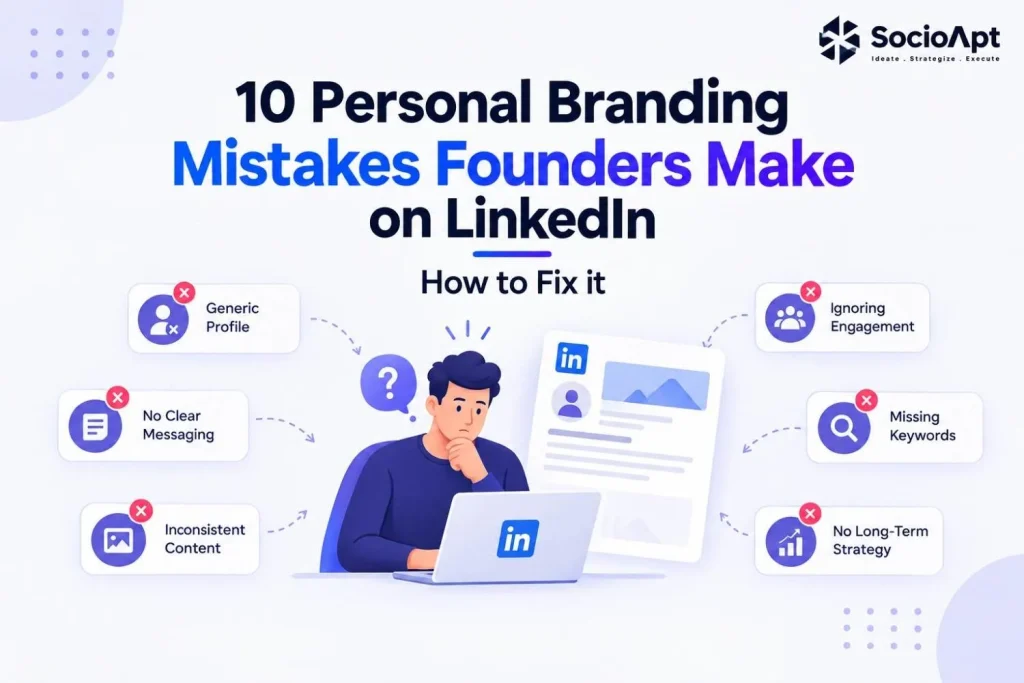
Every founder starts LinkedIn the same way. A plan to post twice a week, share a few insights, maybe pick up some leads along the way. Simple enough, right?
Then reality hits. The first few posts go out with energy. Then the posting slows down. The likes trickle in but nothing really moves. Comments feel like a rare event instead of a habit. And slowly, without really deciding to, the account goes quiet again, filed away under “ l’ll get back to it next month.” Self branding on LinkedIn is not just about posting regularly it is about building a recognizable voice, sharing expertise and creating trust with the right audience.
Sound familiar? You’re not alone, and you’re definitely not bad at this.
Here’s the thing it’s not that you don’t have anything worth saying. Most founders have plenty to say. What’s actually happening is far simpler you’re falling into the same 10 traps almost every founder falls into when they start out on this platform. The good news is that once you can see them clearly, they’re genuinely easy to fix.
Mistakes That Happen Before You Even Post
Before a single post goes out, most founders have already made a mistake sitting right at the top of their profile. It’s easy to overlook, because it doesn’t feel like a mistake in the moment. You fill in your headline, add your job title, list a few skills, and move on to the “real” work of posting content. But your profile is usually the first thing a stranger sees, way before they read a single post of yours. And most founders spend five minutes on it before forgetting it exists.
Mistake 1: Considering LinkedIn to be Your CV
Founders tend to create their profile in the same way they used to create CVs in the past job titles, companies they worked with, a list of skills, work experience, etc. This gives all the information about the past achievements of the author and does not tell anything about current abilities. It is typical for many LinkedIn profiles where authors use only a generic headline “Founder & CEO at [Company]”, without any additional information. It is accurate, but it gives absolutely no reasons for a new follower to become one.
How to fix it:
- Replace generic headline with an outcome statement, e.g. “Helping D2C brands” instead of “Founder & CEO”
- Describe who do you help and how in the About section, in clear and concise words, not industry related word
- Consider your LinkedIn profile as a landing page to be converted into a follow request
Mistakes Around Content Itself
Once your profile is fixed, the next problem shows up in what you actually post, week after week. This is where most of the actual effort goes, and also where most of it quietly gets wasted. You’re showing up, writing something, hitting publish. On paper, that looks like progress. But showing up isn’t the same as showing up well. A lot of founders post consistently for months and still don’t build any real traction, simply because the content itself is working against them without their realizing it.
Mistake 2: Only Posting on Accomplishments, Not On Process or Opinion
The “excited to announce…” post gets the appropriate scrolling past. It seems that founders never come around unless there is something to announce, whether it be a launch, milestone or an award. What results from such a feed? The followers see your accomplishments but never how you got there, your thoughts or the mistakes along the way. Over time, this makes you seem distant and aloof, more like a performer of successes than a maker of them.
How to fix it:
- Make sure for every one announcement post, you have planned out two process or opinion posts to balance the feed
- Write about what you learned by doing something, not just about the thing itself
- Describe your mistake or a pivot just as well as you would describe a success
Mistake 3: Having No Clear Point of View
Scroll through most founders’ feeds and the content starts to blur together: same tips, same phrasing, same safe takes that could’ve been written by anyone in the industry. This usually isn’t intentional. It happens because founders default to “safe” advice that’s technically correct but says nothing distinct about how they specifically see their space.
How to fix it:
- Pick a stance your industry doesn’t usually take publicly, and say it clearly
- Write from your own specific experience rather than repeating common, widely-shared advice
- Prioritize being memorable over being universally agreeable
Mistake 4: Excessively Polishing Everything You Post
Three rewrites before everything seems too polished to be true. Oddly enough, that’s precisely why no one will remember anything you posted. This happens because founders want to avoid coming off as unprofessional, so they end up posting stuff that actually comes across as too professional.
How to fix this:
- Speak to people the way you would speak to a co-worker, then cut back only to clarify
- Leave a few things uncorrected in your writing – it proves you’re an actual human being
- Save the serious editing for the service pages and proposals you send
Mistake 5: Copying Trends Instead of Developing Your Own Voice
Focusing entirely on the current trend and format du jour without any unique perspective of your own makes an entire profile look reactionary. This happens particularly often after a particular kind of post goes viral (topical listicles, unpopular opinions, a certain kind of hook), and everybody adopts the same format within days.
How to Fix this:
- Use trends as inspiration for your own opinion, not something to follow blindly
- Ask yourself what you personally think about it, even if your stance differs from the common one
- Voice consistency over following every fad that passes by
Mistakes Around Consistency and Structure
Even with strong individual posts, many founders lose momentum because of how (or how rarely) they show up. LinkedIn rewards accounts that appear in the feed regularly, so a great post followed by weeks of silence resets much of the goodwill it earned. These mistakes are less about what you say and more about the system behind it, from irregular posting to unclear themes and no plan for what comes next.
Mistake 6: Posting in Bursts, then Vanishing
Post five times in a week, then vanish for a month. This is perhaps the most frequent mistake I see on founder’s LinkedIn profiles, and it runs contrary to both algorithm and audience expectations. This occurs because content posting is purely based on motivation, thus bursts when you feel inspired and stops once everything gets hectic.
How to Fix this:
- Pick a realistic cadence. It’s always better to post two consistent posts per week rather than 10 posts in a burst
- Write the content in a batch so that the act of posting doesn’t depend on inspiration every day
- Make consistency your strategy, not an additional feature of a good content strategy
Mistake 7: Not having content pillars
Putting up whatever is on your mind for the day is second nature, but it means that your readership never knows what they can count on you for. Without content pillars, a CEO’s content stream could be jumping from an industry analysis, to a personal update, to a product release, without anything tying it all together.
How to Fix this:
- Decide on 3-4 themes you will revisit: industry insights, how you build, what you’ve learned along the way, your predictions for the future of your industry
- Switch between those content pillars rather than reacting and posting according to mood
- Give yourself some structure so that your readers have a reason to count on you
The Part Everyone Skips: Engagement
Publishing content is only half of what makes LinkedIn work. The other half happens after the post goes live. Most founders hit publish and move on, treating the post as the finish line instead of the starting point. But that’s exactly when the real work begins, in the comments, the replies, and the conversations that follow.
Mistake 8: Ignoring Comments and Not Engaging Back
Comments come in, and they go unanswered. This is one of the easiest wins left on the table, and one of the most commonly skipped.
Founders often treat commenting back as optional or secondary, especially when they’re busy, without realizing what it costs them in reach.
How to fix it:
- Reply to every comment within the first hour of posting
- Ask a follow-up question in your reply to extend the conversation further
- Treat comments as the actual audience-building mechanism, not a side effect of posting
Mistake 9: Using LinkedIn Only to Broadcast, Never to Connect
Posting and leaving is the equivalent of giving a speech and walking out of the room before anyone can respond. It’s a one-way use of a platform built around two-way presence. This mistake is invisible to the founder making it, since their own feed looks active. But their broader presence in other people’s feeds is nearly zero.
How to fix it:
- Spend as much time commenting on others’ posts as writing your own
- Engage with people in your target audience specifically, not just other founders in your niche
- Remember that visibility compounds when people see you show up in their feed too, not just your own
The Mistake That Undoes Everything Else
The final mistake isn’t about a post, a profile section, or a habit. It’s about how founders judge whether any of this is working.
Mistake 10: Giving Up Without Seeing the Outcome
Three weeks of posts with no viral sensation, and the result is “LinkedIn doesn’t work for me.” Compounding in personal branding happens slowly over time, and the majority of founders stop right before it starts to compound.
This is the mistake that ruins all other solutions because even if your profile and posting strategy are perfect, you will still need some time.
How to Fix this:
- The first 90 days should be measured by consistency and content quality, not by the number of followers
- Focus on the trends in engagement once per month rather than analyzing every single post
- Expect inbound traffic to arrive unexpectedly and abruptly
Need a Personal Branding LinkedIn Strategy Designed for You?
This is something which can be done one mistake at a time. Reading through this list and being more conscious about your future posts will take you way further than most founders who use the LinkedIn platform. However, knowing what not to do is quite different from actually having a personal brand system that functions seamlessly over the month. When you have to run the company, manage a team, and take care of a bunch of other responsibilities, LinkedIn often becomes the last thing to do when everything else gets really busy, even when you know exactly what you should do on the platform. Creating a systematic process where your personal brand builds on itself month after month is quite another ballgame. It requires a distinct voice, a content plan which does not depend on your inspiration every day, a schedule which works even when you are really busy, and an engagement strategy being executed by someone else. Our personal brand service create this entire process for you: voice, content pillars, posting schedule and an engagement strategy, while making your presence on LinkedIn grow consistently behind the scenes.
The Bottom Line
None of these 10 mistakes are about lacking something to say. They’re about approach- treating a relationship platform like a broadcast channel, and expecting instant results from a process that compounds over months. Fix the profile. Build a clear point of view. Post consistently. Engage as much as you publish. Give it the 90 days it actually needs before judging the results. That shift is the difference between a LinkedIn profile that sits quiet and one that becomes a real, ongoing source of visibility and trust.
Frequently Asked Questions
1. What is the single biggest personal branding mistake founders make on LinkedIn?
Treating LinkedIn as a broadcast channel rather than a relationship channel is one of the biggest personal branding mistakes founders make. Posting without engaging back and expecting visibility without consistency over time can limit results. Many founders approach LinkedIn like a press release: write it, publish it, and move on. But LinkedIn is built around conversation, not just announcements. A post that gets no replies, comments, or follow-up from the founder themselves rarely goes very far, no matter how well it is written.
2. At what frequency should founders post on LinkedIn to establish a personal brand?
A realistic and sustainable frequency, usually around twice per week, works better than posting in short sprints and then being silent for a while. Consistency over time is important for building a personal brand. There is no perfect number that works for every founder. The most important thing is being able to sustain the posting frequency. Posting twice a week consistently for six months can provide more value than posting five times per week for three weeks and then stopping.
3. How long does it typically take to see real results from LinkedIn personal branding?
For many founders, the 90-day rule is meant to emphasize consistency and quality rather than reach. The cumulative effects of regular posting and engagement can begin to show after around 90 days, helping build visibility and interest. For founders who remain consistent, more noticeable results may start appearing between the fourth and sixth month as their content, engagement, and professional presence build over time.
4. Does replying to comments actually affect how far a LinkedIn post reaches?
Yes, replying to comments can help encourage further discussion around a LinkedIn post. Responses, especially soon after publishing, can keep the conversation active and give people more opportunities to engage with the post. Replies that create an ongoing discussion can generate more interaction than reactions alone. Responding to comments also keeps the conversation going with people who have already shown interest in the post.