
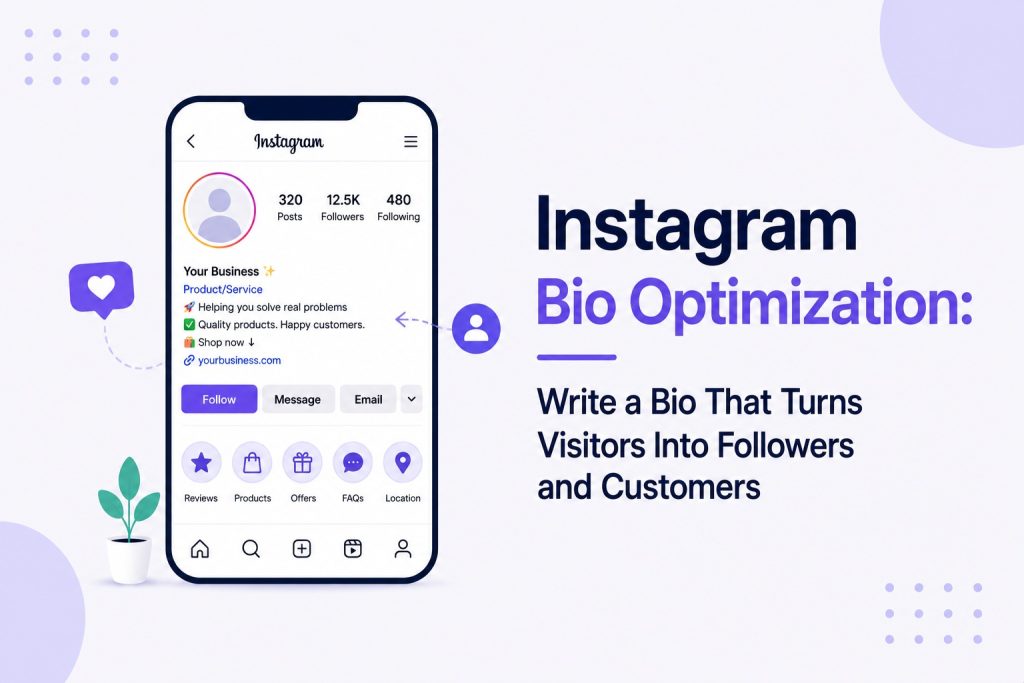
You have 150 characters.
That is roughly the length of two short sentences. In that space, you need to tell a new visitor who you are, what you do, why they should care, and what to do next.
Most businesses burn all 150 on describing themselves in ways that could apply to any competitor in their category.
This guide goes deep on the bio specifically: every line, every word choice, every structural decision that determines whether someone stays or moves on.
Why the Bio Is the Highest-Leverage Element on Your Profile
Every other part of the profile supports the bio. The profile photo earns the glance. The grid earns the scroll. The bio earns the decision.
When someone lands on your profile, they are asking one question: is this account for me? The bio answers it or it doesn’t.
A bio that fails to answer this clearly means the rest of the profile does not matter, because the visitor has already moved on before reaching it.
What a converting bio actually needs to communicate:
- What the business does, in terms the visitor would use themselves
- Who it does it for, specifically enough that the right person feels seen
- Why this account rather than any other account in the category
- What the visitor should do right now
That is four distinct jobs in 150 characters. Every word needs to carry its weight.
The bio is just one element of the profile, but it is the one that does the most work. For a complete walkthrough of every other profile element and how they work together, this guide on Instagram profile optimization covers the full picture.
The Three-Line Structure That Works
Instagram bios display across multiple lines with line breaks. Using that structure intentionally creates visual hierarchy that makes scanning easier for a visitor in the middle of a three-second decision.
Line 1: The hook
This is the most important line. It tells the visitor immediately whether this account is relevant to them.
It should state what you do and who you do it for in plain language.
Line 2: The proof
This is the credibility line. It gives the visitor a specific reason to believe you can do what line 1 promises.
Line 3: The call to action
This line tells the visitor exactly what to do next. It should be specific, not generic.
Why this order matters:
Most businesses put their CTA on line 2, before they have given the visitor any reason to act. That is backwards. Someone who does not yet believe you can help them is not going to click a link or DM you. The proof has to come before the ask.
Writing Line 1: The Hook That Earns the Next Two Lines
Line 1 is doing the job of a headline. If it does not immediately signal relevance, the visitor never reads lines 2 or 3.
What a strong first line does:
- Names the specific person or situation the account is for
- Uses the language that person would actually use, not internal brand language
- Creates an immediate “this is for me” or “this is not for me” response, with the goal being a clear yes from the right person
The structure that consistently works:
“[Verb] [specific audience] [achieve specific outcome]”
- “Helping Edinburgh homeowners sell faster for more”
- “Teaching freelancers to raise rates without losing clients”
- “Custom cakes for weddings and events across Manchester”
What a weak first line looks like:
- “Passionate about creating beautiful experiences”
- “Your local marketing experts”
- “We love what we do and it shows”
None of these answer the visitor’s question. They describe how the business feels about itself, not what the visitor gets from following.
The specificity test:
Replace your business name with a competitor’s name. If the line still works, it is not specific enough. A strong first line could only belong to your specific account.
Writing Line 2: The Proof That Earns the Click
Line 2 is where most bios either build real credibility or fall into generic claims.
“Over 10 years of experience” does not build credibility. Every business says that. A specific number that the visitor can visualize does.
Proof types that actually work:
- Volume numbers – “3,400 clients served,” “400+ weddings photographed,” “12 million impressions generated”
- Outcome stats – “Average client sees 40% more leads in 90 days,” “98% of our students pass first time”
- Social proof indicators – “As seen in Forbes, BBC, and The Guardian,” “Trusted by 200+ small businesses”
- Specific credentials – “Certified Google Partner,” “RYT 500 Yoga Instructor,” “RICS Chartered Surveyor”
- Notable clients or partners – “Working with Nike, Deliveroo, and Monzo”
What to avoid:
- “Experienced team” (not specific)
- “Award-winning service” (which award, when, for what?)
- “Trusted by thousands” (thousands of whom?)
The difference between weak and strong proof is specificity. A visitor reading “3,400 clients served” can picture that number. “Trusted by thousands” asks them to take your word for it with no anchor.
Writing Line 3: The CTA That Actually Gets Clicks
The call to action is the most practically important line in the bio because it determines whether all the work done by lines 1 and 2 converts into an action.
Most business CTAs are either too vague or too generic to drive behavior.
What a weak CTA looks like:
- “DM us!” (for what?)
- “Click the link below” (to go where?)
- “Shop now” (for what reason right now?)
What a strong CTA looks like:
- “Book your free 30-min strategy call via the link”
- “Download the free guide to [specific outcome] below”
- “DM us ‘QUOTE’ for a free renovation estimate”
- “Get 15% off your first order via the link”
- “See our portfolio and book a date below”
The strong versions tell the visitor exactly what they will get when they take the action, not just that there is a link. Specificity removes the hesitation that generic CTAs create.
CTA and link alignment:
Whatever the CTA promises must be what the link in bio delivers. A CTA that says “Get the free guide” linking to a homepage creates a disconnect that kills conversions. The link should take the visitor directly to what the bio promised.
How Keywords Fit Into the Bio
The bio itself is not heavily searchable in the way the name field is. But it still contributes to relevance signals, and natural keyword inclusion helps the account feel specific and clearly positioned rather than vague.
How to include keywords naturally:
- Line 1 often naturally includes keywords if it is written specifically enough (“custom wedding cakes Manchester” is both a hook and a keyword)
- Specialty terms and location names in lines 1 and 2 reinforce what the account is about
- Do not force keywords into the bio at the cost of clarity or readable flow
The bio-name field-category system:
The bio does not operate in isolation. It works alongside two other elements:
- The name field (the most searchable element, should include your primary keyword)
- The category tag (a business-set category that appears below the name and signals the account type to both visitors and search)
These three work as a system. If the name field contains “Custom Wedding Cakes Manchester” and the category says “Bakery,” the bio can focus entirely on converting the visitor rather than repeating keyword information that is already elsewhere.
For a full breakdown of how the name field, alt text, captions, and hashtags all work together as an Instagram search system, this guide on Instagram SEO covers keyword strategy across every optimizable field.
Emojis in the Bio: When They Help and When They Hurt
Emojis in bios are widely used and widely misused. They can improve scannability or they can make a bio look cluttered and unprofessional. The difference comes down to how and where they are used.
When emojis help:
- Used as a bullet point replacement at the start of a line to improve visual separation without a formal list
- Used to replace a word or phrase that would otherwise take up character space
- Used when the brand tone genuinely includes warmth or playfulness and the emoji matches that tone
When emojis hurt:
- Scattered throughout lines in a way that interrupts reading flow
- Used to decorate rather than communicate (five star emojis before and after the business name)
- Used in professional or high-trust categories where the visual tone creates cognitive dissonance (a medical clinic or legal firm using casual emojis signals a mismatch)
- Used to replace words that the visitor actually needs to read for clarity
The simple test:
Remove the emojis and read the bio. Does it communicate better or worse without them? If worse, they are doing real work. If the same or better, they are decoration and can go.
Bio Formulas by Business Type
The same three-line structure applies across business types, but the content of each line shifts based on what the visitor needs to know to take action.
Local service business (plumber, cleaner, electrician):
Line 1: What you do + where you serve
Line 2: Reliability or proof signal (years in business, jobs completed, response time)
Line 3: How to get a quote or book
Example:
“Emergency plumbing across Greater London
24/7 response, 1,200+ jobs completed
Call or DM for a same-day quote”
E-commerce / product business:
Line 1: What the product is and who it is for
Line 2: What makes it different or a specific social proof signal
Line 3: Shop the link + current offer or incentive
Example:
“Handmade ceramic homeware, designed in Bristol
Small-batch, zero-waste production
New drops every Friday via the link”
Coach, consultant, or service professional:
Line 1: Who you help + the specific outcome you produce
Line 2: Credibility indicator (number of clients, press, qualification)
Line 3: Entry point (free resource, consultation, newsletter)
Example:
“Helping B2B founders close larger deals faster
50+ clients, featured in Entrepreneur Magazine
Get the free sales framework via the link”
Personal brand / creator:
Line 1: What you create or teach and for whom
Line 2: Why you have the authority to do it
Line 3: Where to go to learn more or engage
Example:
“Honest money advice for people in their 30s
Former banker, now financial educator
New video every Thursday below”
Restaurant, cafe, or food business:
Line 1: What type of food and the specific atmosphere or identity
Line 2: Key proof or differentiator (awards, press mention, feature)
Line 3: Reservation or menu link
Example:
“Korean-Italian fusion dining in Shoreditch
Listed in Time Out’s 50 Best London Restaurants
Book your table below”
How the Bio Changes Based on Your Primary Goal
The same business can have different bio priorities at different stages. The bio should reflect the current primary goal, not a permanent description that never updates.
Goal: Build awareness and followers
Lead with content value. The bio should communicate what the visitor gets from following, not what the business sells.
Example: “Behind-the-scenes of building a UK bakery from scratch. New video every Tuesday. Follow for the unfiltered truth.”
Goal: Generate leads
Lead with the outcome. The bio should make the lead magnet or consultation offer immediately visible and compelling.
Example: “Helping small businesses get found on Google. Free 30-min SEO audit via the link below. 200+ businesses helped.”
Goal: Drive direct sales
Lead with the product and the offer. The bio should remove every barrier between the visitor and the purchase.
Example: “Handmade leather wallets, made in Scotland. Free shipping on all UK orders. Shop the link.”
Most businesses write a permanent bio for one of these goals and then wonder why the others do not convert. A bio built around awareness does not convert leads. A bio built around sales does not build community. Update it when the primary goal shifts.
Common Bio Patterns That Hurt Conversion
These are the patterns that appear most often in small business bios and consistently underperform.
The feelings bio:
“We are passionate about creating beautiful, meaningful experiences for our clients.”
No specific person, no specific outcome, no reason to click. Replace with a specific audience and outcome.
The list of services bio:
“Photography | Videography | Editing | Branding”
This is a menu, not a pitch. The visitor still does not know why this account is the right choice. Add who it is for and what makes it different.
The awards bio:
“Award-winning boutique agency. Excellence in marketing.”
Which award? From whom? When? Vague credibility is not credibility. Replace it with a specific, named credential or outcome.
The team bio:
“A passionate team of creatives helping brands tell their story.”
No specific audience, no specific outcome, no reason to follow. Every agency on earth could use this bio. Specificity is the fix.
The motivational bio:
“Dream big. Work hard. Make it happen.”
This belongs on a motivational poster, not a business Instagram profile. Replace it with a direct statement of what the business does and for whom.
How to A/B Test Your Instagram Bio
The bio can be updated any time without any historical consequence to the profile. This makes it one of the easiest profile elements to test.
A simple testing approach:
- Change one element at a time: the hook, the proof line, or the CTA
- Run the bio for two to three weeks and monitor link in bio click rate via Instagram Insights
- If click rate improves after a change, the new version is working better
- If click rate stays the same or declines, revert and test a different change
What to test first:
Most bio improvements come from the first line and the CTA, since these are the two highest-leverage positions. Start by testing two different versions of line 1 (same proof and CTA) and see which generates more profile clicks from content that reaches new people.
Updating Your Bio for Campaigns and Seasons
A static bio treats every period of the year and every campaign the same. A strategic bio updates to match what the business is prioritizing right now.
When to update the bio:
- Product launches: add the launch in line 2 and update the CTA and link to go directly to the new product
- Seasonal promotions: add the offer or the deadline in line 3 so every profile visitor during the campaign sees it
- Award wins or press features: add the specific credential to line 2 for maximum credibility impact
- Waitlist campaigns: replace the link CTA with a waitlist sign-up link and reference it explicitly in line 3
- Events: add the date and registration link when an upcoming event is the priority conversion
How often to review:
Once a month as part of the planning session. Most bios need minor tweaks monthly and a full rewrite every three to six months as the business evolves, the audience matures, and the primary goal shifts.
Measuring Whether Your Bio Is Working
A bio that is not tracked is a bio that cannot be improved.
The key numbers to watch:
- Link in bio click rate – Available under Profile Activity in Instagram Insights; the primary indicator of whether the CTA is working
- Profile visit to follow conversion rate – If profile visits are high but follow rate is low, the bio is not giving visitors enough reason to commit
- DM volume from new visitors – If the bio includes a DM CTA, the volume of relevant inbound DMs tells you whether the prompt is specific enough to act on
- Bounce rate on the link destination – Via Google Analytics with UTM tracking; a high bounce rate means the link destination does not match what the bio promised
For a full framework covering which metrics matter most for each business goal, alongside the KPIs that connect bio performance to actual revenue, this guide on important social media KPIs to track for small businesses covers every metric with clear benchmarks.
How a Strong Bio Compounds With Growth Tactics
A bio that converts well makes every other Instagram strategy more effective.
When a Reel drives profile visits, a strong bio converts those visits into followers. When a collaboration introduces new audiences to the account, a strong bio converts that traffic. When search brings a new visitor, a strong bio earns the follow.
A weak bio is a hole in the bucket. Traffic pours in through Reels, search, and collaborations, and most of it leaves without converting because the bio gave them no clear reason to stay.
For the complete system of growth tactics that a strong bio should be supporting, this guide on Instagram growth strategy for small businesses covers the full approach from Reels to collaborations to cross-promotion.
Want Someone to Write and Optimize Your Bio for You?
Getting the bio right takes real thought about positioning, audience, and conversion psychology, not just filling in a template.
Our social media marketing services include full profile setup and optimization, which means the bio, the link strategy, and every other profile element gets built with the same care and specificity this guide describes.
The Bottom Line
The bio is 150 characters. Those characters have one job: answer the visitor’s silent question about whether this account is worth their time.
Line 1 tells them what you do and who you do it for. Line 2 gives them a reason to believe it. Line 3 tells them exactly what to do next.
Every word should earn its place. Everything vague should be made specific. And the whole thing should be reviewed at least monthly, because a bio that no longer reflects what the business is currently trying to achieve is quietly leaking potential every day.
Frequently Asked Questions:
1. What should a small business Instagram bio include?
An effective small business Instagram bio should include three core elements across its line structure: a first line that states clearly what the business does and who it does it for, a second line that provides a specific, believable proof element such as a number of clients served or a named credential, and a third line with a direct call to action tied to the most important conversion action right now. Within 150 characters, every word should answer whether this account is relevant to the visitor and what they should do about it.
2. How many characters should an Instagram bio be?
Instagram allows up to 150 characters for the bio. The most effective bios use close to the full character count across three distinct lines, since the line break structure creates visual hierarchy that makes the bio easier to scan quickly. Using significantly fewer than 100 characters often signals that the bio is underspecified and not giving visitors enough information to make a decision about following or clicking.
3. What should the first line of an Instagram bio say?
The first line should immediately tell the visitor who the account is for and what they will get from it, using language the target audience would actually use. It should create an immediate yes or no response: the right person should feel seen, and the wrong person should self-select out. A useful test is replacing the business name with a competitor’s name: if the first line still works, it is not specific enough to differentiate the account.
4. What makes a good proof element for line 2 of an Instagram bio?
Effective proof elements are specific and verifiable rather than vague. Volume numbers such as the number of clients served, jobs completed, or students helped are strong because they give the visitor a concrete anchor. Named press features or credentials are strong because they carry third-party authority. Generic phrases like “experienced” or “trusted by thousands” are weak because every business claims them and they provide no specific reason to believe.
5. How do you write a bio call to action that actually drives clicks?
A bio CTA that drives clicks tells the visitor specifically what they will get when they take the action, not just that there is a link. “Download the free guide to tripling your Instagram reach” drives more clicks than “Click the link below.” The CTA should align precisely with where the link takes the visitor: if the bio promises a free consultation and the link goes to a homepage, the disconnect reduces conversions significantly.
6. Should small businesses use emojis in their Instagram bio?
Emojis can help when they improve visual scannability, replace words to save character count, or genuinely match the brand’s tone. They hurt when they clutter the reading flow, appear in high-trust professional categories where they create a tone mismatch, or substitute for clarity. The practical test is removing the emojis and checking whether the bio communicates better or worse without them: if the same or better, the emojis are decoration rather than communication.
7. How should the bio change based on the business goal?
A bio built for awareness should lead with what the visitor gets from following, such as regular content value on a specific topic, and save the conversion CTA for a softer ask. A bio built for leads should lead with the outcome and make the lead magnet or consultation offer immediately visible. A bio built for direct sales should lead with the product and remove every barrier between the visitor and the purchase. A static bio that never updates is likely optimized for none of these goals effectively.
8. How do keywords fit into the Instagram bio?
The bio itself is less searchable than the name field, but natural keyword inclusion reinforces relevance signals and makes the account feel positioned rather than generic. The most effective approach treats the bio as one element of a three-part keyword system alongside the name field and category tag. The name field carries the primary keyword for search. The bio focuses on converting the visitor, with keywords appearing naturally as a result of specific, clear language rather than forced insertion.
9. How often should a small business update its Instagram bio?
The bio should be reviewed monthly as part of the regular social media planning cycle. Minor updates to the CTA or proof element may be needed when campaigns or promotions change. A full rewrite may be appropriate every three to six months as the business evolves, the audience matures, or the primary goal shifts. A bio written for a launch campaign but never updated afterward will continue to reference that campaign long after it is relevant, which creates a mismatch between the bio promise and the reality of the account.
10. How do you know if your Instagram bio is actually working?
Track the link in bio click rate through Instagram Insights under Profile Activity, which directly measures whether the CTA is converting visitors into clicks. Also monitor the profile visit to follow conversion rate: high profile visits with a low follow rate points specifically to the bio failing to give visitors a compelling reason to commit. For businesses with a DM-based CTA, inbound DM volume from new visitors confirms whether the prompt is specific enough to generate responses