
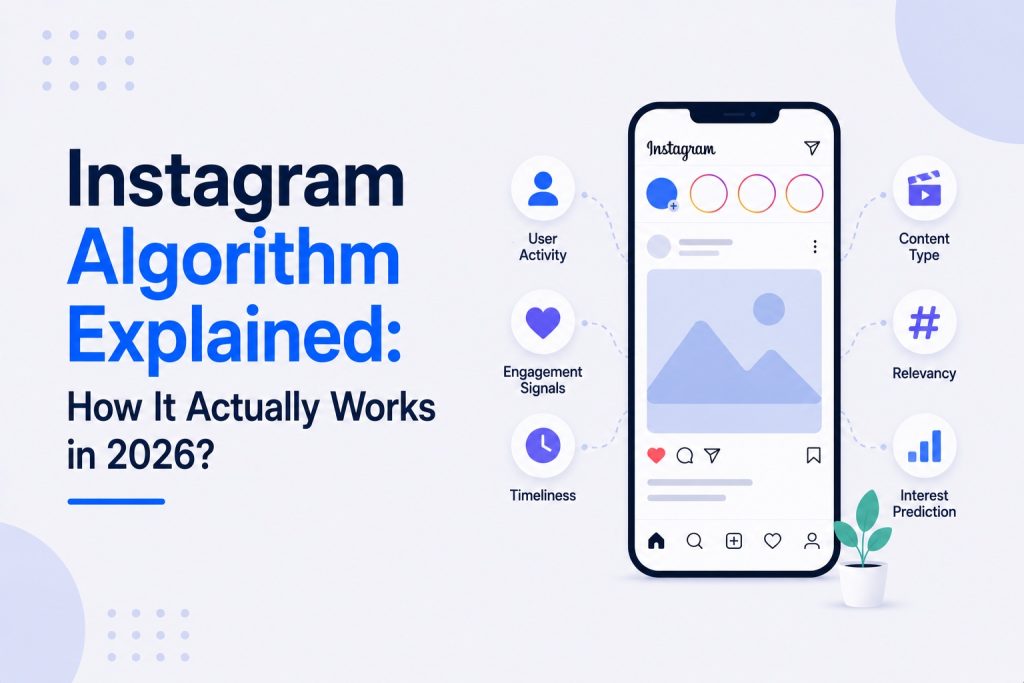
There is no single Instagram algorithm.
That is the first myth to clear up, and it explains why so much advice about “beating the algorithm” misses the point entirely.
Instagram runs several different ranking systems, one for each surface: Feed, Stories, Reels, Explore, and Search. Each one looks at different signals and optimizes for a different outcome.
This guide explains how each of those systems actually works, based on what Meta has officially confirmed, not speculation or recycled myths.
Why “The Algorithm” Is the Wrong Way to Think About It
Treating Instagram as one system leads to bad decisions.
A tactic that helps a Reel get discovered will not necessarily help a feed post reach more people. A hashtag strategy built for Search visibility behaves differently from one built for Explore.
What this means practically:
- Optimizing only for “the algorithm” leads to generic advice that does not match how any specific surface actually works
- Different content needs to be evaluated by the ranking logic of the surface it lives on
- A post that flops in the main feed might be the exact type of content that performs well in Explore, or vice versa
Meta’s own Head of Instagram, Adam Mosseri, has repeatedly confirmed this distinction publicly. Each surface exists to solve a different problem for the user, and is ranked accordingly.
How the Instagram Feed Algorithm Works
The Feed is built to show people content from accounts they already follow, ranked by how likely they are to care about it.
The ranking signals Meta has officially confirmed for Feed:
- Information about the post – How popular it is, when it was posted, how long it is (for video), and what general topic or location it relates to
- Information about the person who posted it – How interesting or engaging that account’s content has been to people in general recently
- Your activity – How many posts you have liked, what content you have engaged with in the past, and how you interact with similar content
- Your interaction history with the poster – How often you comment on each other’s posts, whether you message each other, and whether you are tagged together in photos
What this means for content strategy:
- The Feed prioritizes relevance to the individual viewer over raw popularity
- A post can perform very differently across different followers, since each person’s Feed ranking is personalized
- Building genuine, two-way engagement with your audience (comments, replies, DMs) directly strengthens how often your content appears in their Feed going forward
The Feed algorithm rewards relationships more than any other surface. This is one reason replying to comments matters so much: it is a direct signal that improves future visibility with that specific follower.
How the Reels Algorithm Works (And Why It Is Different)
Reels exists primarily to help people discover new content and new accounts, which means its ranking logic is built around a different goal than the Feed.
The ranking signals Meta has confirmed for Reels:
- Activity – Likes, comments, shares, watch time, and whether someone completes the video
- Interaction history – Past engagement with the specific account or with similar content
- Information about the Reel – Audio track, visual elements detected in the video, and popularity
- Information about the person posting it – Their general follower engagement level and recent activity
The single biggest difference from Feed: Reels are shown extensively to people who do not follow the account at all. This is the entire reason Reels function as the strongest discovery tool on the platform.
What this means practically:
- Watch time and completion rate matter disproportionately for Reels, since the system is trying to predict whether a wider, mostly unfamiliar audience will stay engaged
- A strong hook in the first 2 to 3 seconds is not just a content tip, it directly affects the data points the algorithm uses to decide further distribution
- Reels that perform well early (within the first hour or so) tend to get pushed to progressively larger audiences in a feedback loop
This is why a small account with one strong Reel can suddenly reach thousands of new people. The Feed algorithm could never produce that outcome, since it is built around existing relationships, not discovery.
For a deeper breakdown of how to apply this specifically to grow a following, this guide on Instagram growth strategy for small businesses covers the tactical side of working with this discovery mechanism.
How the Stories Algorithm Works
Stories ranking is built around a different priority entirely: showing people the content from accounts they engage with most, in roughly the order they are most likely to want to see it.
Signals that influence Stories ranking:
- How often you view and engage with that account’s Stories historically
- How close your relationship is with the account (DMs, comments, mutual tags)
- How recently the Story was posted
- Direct engagement with previous Stories (replies, sticker interactions, taps to skip)
What this means practically:
- Stories are a relationship-reinforcement tool more than a discovery tool
- Frequent Story posting trains the algorithm to keep showing your content near the front of a follower’s Stories tray
- Low engagement on Stories (frequent skipping) over time can reduce how prominently your future Stories are shown to that specific viewer
This is why interactive elements like polls, questions, and quizzes matter beyond just engagement for its own sake. Each interaction reinforces the relationship signal that determines future Story placement.
How the Explore Page Algorithm Works
Explore is built specifically to surface content from accounts a person does not yet follow, based on predicted personal interest.
Signals that influence Explore ranking:
- Post information, including likes, comments, and how quickly engagement accumulated
- Your activity history, including what you have liked, saved, and engaged with previously
- Your history interacting with the poster, even indirectly (such as following similar accounts)
- Information about the poster, including their general engagement levels with the broader Explore audience
What this means practically:
- Explore rewards content that performs well with a broad, mostly unfamiliar audience, similar to Reels but extending across multiple content formats
- Saves and shares carry significant weight here, since they indicate strong relevance beyond a passing like
- Content that performs unexpectedly well organically (high engagement relative to follower count) is the clearest signal Explore uses to justify wider distribution
Explore functions as a secondary discovery engine alongside Reels, and the same principles, strong hooks and genuinely useful or interesting content, apply across both.
How Instagram Search Actually Works
Instagram Search has increasingly started to function more like a traditional search engine, ranking content based on relevance to specific keywords and phrases rather than purely social signals.
What influences Search visibility:
- Keywords used in your bio’s name field, which is directly searchable
- Keywords used naturally in captions and alt text
- Account activity and engagement levels, similar to other surfaces
- Relevance matching between the search term and the actual content of the post
What this means practically:
- Writing captions with natural, descriptive language that matches how your audience actually searches improves long-term discoverability
- Keyword stuffing or unnatural phrase repetition does not reliably improve Search ranking and can hurt the readability that drives genuine engagement
- Search functions as a slower-burning, evergreen discovery channel compared to the immediate spikes possible through Reels and Explore
What Meta Has Officially Confirmed (vs. What Is Speculation)
A huge amount of “algorithm advice” online is guesswork dressed up as fact. Separating the two matters.
Officially confirmed by Meta:
- The existence of separate ranking systems for each surface (Feed, Stories, Reels, Explore, Search)
- The general categories of signals used: post information, poster information, your activity, and your relationship history
- That engagement speed and watch time matter significantly for video content distribution
- That the algorithm personalizes rankings individually for each user, meaning the same post can rank very differently across different viewers
Commonly claimed but not officially confirmed:
- Specific numerical thresholds (such as exact comment counts) required to “trigger” wider distribution
- Precise weighting of one signal versus another (Meta has never published an exact formula)
- Claims that posting at an exact specific time of day guarantees better reach
- Most specific hashtag count “rules” presented as fixed mechanics rather than general best practice
Treat anything presented as an exact, universal number with skepticism. Meta’s own communications consistently describe the system as personalized and constantly evolving, which makes fixed numerical rules unreliable by definition.
What a Shadowban Actually Is (And What It Is Not)
“Shadowban” is one of the most misunderstood terms in Instagram marketing.
What it is not:
- A single, official Meta feature called “shadowban” does not exist as commonly described
- Most perceived shadowbans are actually normal reach fluctuation caused by content quality, posting consistency, or algorithm changes affecting many accounts simultaneously at once
What is actually happening when reach drops suddenly:
- The account may have violated community guidelines in a way that reduces distribution, which Meta does acknowledge happens for policy violations
- Recent content may simply be performing worse on the specific signals each surface evaluates
- A platform-wide algorithm update may be affecting a broad set of accounts, not just one specific account
- Reduced engagement from following the account’s own posting or engagement habits dropping off, which reduces the relationship signals driving Feed and Stories distribution
If reach drops suddenly and significantly, the more useful response is auditing recent content quality and consistency rather than assuming a mysterious, unexplained penalty has been applied.
Why Two Similar Posts on the Same Account Can Perform Completely Differently
This is one of the most common frustrations small businesses run into, and the algorithm mechanics explain exactly why it happens.
The main reasons identical-feeling posts perform differently:
- Early engagement velocity differs – One post happens to catch attention faster in the first 30 to 60 minutes, which compounds into wider distribution
- Audience context differs – The exact moment someone sees a post (what else is in their feed at that time, their mood, their recent activity) affects whether they engage
- Small format differences matter more than they seem – A slightly stronger hook, a different first frame, or a more specific caption changes how the algorithm scores the content even if the topic is identical
- Timing relative to platform-wide trends – Posting around a moment when a similar audio, format, or topic is already gaining traction can meaningfully boost a post’s relative performance
This is also why testing matters more than any single “best practice.” Posting similar content multiple times with small variations reveals what specifically is driving performance differences for your particular audience.
How the Algorithm Learns About an Individual User Over Time
Every ranking decision is personalized, which means the algorithm is continuously building a profile of what each individual user cares about.
What it learns from:
- Every like, comment, save, and share
- Time spent on specific pieces of content, even without any visible interaction
- Accounts followed, unfollowed, muted, or blocked
- Search terms used and accounts found through search
- Direct messages and who someone interacts with privately (used for relationship signals, not message content)
What this means for content strategy:
The algorithm is not evaluating your content in a vacuum. It is constantly trying to match your content against a specific, evolving profile of each individual viewer’s demonstrated interests.
This is exactly why a tightly defined audience and content niche performs better over time. The algorithm has an easier time confidently matching specific, consistent content to the right people than it does with broad, unfocused content that does not clearly fit anyone’s established interest profile.
How Algorithm Changes Affect Small Businesses Specifically
Instagram updates its ranking systems regularly, sometimes with announced changes and often with smaller, unannounced adjustments.
What this means practically for a small business:
- Reach and engagement can fluctuate for reasons unrelated to anything you changed, simply because the underlying ranking logic shifted
- Strategies that worked extremely well six months ago can underperform today, even with the same content style and quality
- Chasing every individual algorithm rumor or change is less productive than focusing on the fundamentals the algorithm has consistently rewarded across every known update: genuine engagement, watch time, relevance, and consistency
The fundamentals that survive most changes:
- Posting consistently, since every version of the algorithm has rewarded predictable activity over sporadic bursts
- Creating content specific enough to generate strong engagement from the people who actually see it
- Replying to comments and DMs, since relationship signals have remained core to ranking across every major update
- Using video formats that hold attention, since watch time has been a consistent priority across algorithm iterations
Posting consistency in particular remains one of the most reliable levers regardless of how the underlying ranking logic shifts. This guide on how often small businesses should post on social media covers the data-backed frequency range that holds up across algorithm changes.
Common Instagram Algorithm Myths Worth Retiring
Some persistent beliefs about the algorithm do more harm than good when businesses build their strategy around them.
- “Deleting and reposting underperforming content resets the algorithm in your favor” – There is no confirmed mechanism supporting this, and it more often disrupts the consistency signal that actually matters
- “Using too many hashtags gets you penalized” – Using irrelevant or excessive hashtags does not help, but there is no confirmed penalty mechanism beyond simply not improving relevance
- “The algorithm punishes business accounts compared to personal accounts” – No confirmed evidence supports this; perceived differences are more often explained by content quality and consistency differences between the accounts being compared
- “Posting at the exact ‘best’ time guarantees better reach” – Timing affects early engagement velocity, but it is one factor among many, not a guaranteed mechanism on its own
Believing these myths often leads to wasted effort on tactics that do not move the needle, while distracting from the fundamentals that consistently do.
A broader look at the habits and misconceptions that quietly undermine small business social media performance, including several algorithm-related ones, is covered in this guide on social media mistakes small businesses make.
Applying This Knowledge to Your Content Strategy
Understanding the algorithm is only useful if it changes what you actually do.
If you have not yet built the foundational profile and content strategy this knowledge should inform, this Instagram marketing guide for small businesses covers setup, content pillars, and posting fundamentals from the ground up.
Want a Strategy Built Around How the Algorithm Actually Works?
Understanding the mechanics is the first step. Applying that understanding consistently, across every surface and every post, is where most small businesses run out of time and attention.
Our social media marketing services build content strategies specifically around how each platform’s ranking systems actually work, rather than recycled, generic advice.
The Bottom Line
Instagram does not run on one algorithm. It runs several, each built to serve a different purpose: relationships in Feed, discovery in Reels and Explore, anticipation in Stories, and relevance matching in Search.
Understanding which surface your content lives on, and what that surface is actually trying to achieve, explains far more about your results than any single algorithm myth or hack ever will.
Focus on what every version of the algorithm has consistently rewarded: genuine engagement, watch time, consistency, and content specific enough to mean something to the people it reaches. That foundation holds up regardless of how the underlying system changes next.
Frequently Asked Questions:
1. Is there one Instagram algorithm or multiple?
There are multiple ranking systems, not a single algorithm. Instagram runs separate systems for Feed, Stories, Reels, Explore, and Search, each evaluating different signals and optimizing for a different goal. Feed prioritizes relationships and relevance to accounts you already follow. Reels and Explore prioritize discovery and showing content to people who do not yet follow the account. Stories prioritizes relationship strength and recency. Understanding these as distinct systems explains why a single piece of generic “algorithm advice” rarely applies equally across the whole platform.
2. What ranking signals has Instagram officially confirmed?
Meta has officially confirmed four general categories of signals used across surfaces: information about the post itself (popularity, timing, format), information about the account that posted it (general engagement levels), the viewer’s own activity history (what they have liked and engaged with), and the viewer’s relationship history with the specific poster (comments, DMs, tags). Beyond these general categories, Meta has not published exact numerical weightings or thresholds, so specific claims about precise formulas should be treated with skepticism.
3. How is the Reels algorithm different from the Feed algorithm?
The Feed algorithm is built primarily around relationships, showing content from accounts a person already follows ranked by predicted relevance. The Reels algorithm is built primarily around discovery, actively distributing content to people who do not follow the account at all. This is why Reels can reach a much larger, unfamiliar audience quickly, while Feed posts tend to perform more consistently with an account’s existing followers. Watch time and completion rate carry disproportionate weight in Reels ranking because the system is evaluating whether a largely new audience will stay engaged.
4. What is a shadowban and is it real?
A single official Meta feature matching the commonly described “shadowban” does not exist as most people describe it. Sudden reach drops are more often explained by normal algorithmic fluctuation, reduced content quality or consistency, platform-wide algorithm updates affecting many accounts simultaneously, or in some cases reduced distribution following a confirmed community guidelines violation. Rather than assuming a mysterious penalty, auditing recent posting consistency and content quality is a more productive response to a sudden reach decline.
5. Why do two similar posts from the same account get completely different results?
Several factors explain this, even when the content feels nearly identical. Early engagement velocity in the first 30 to 60 minutes after posting can differ significantly and compounds into wider or narrower distribution. The exact context a viewer is in when they see the post, including what else is in their feed at that moment, affects whether they engage. Small differences in hook strength, first frame, or caption specificity also change how the algorithm scores otherwise similar content.
6. Does posting at a specific “best time” actually improve Instagram reach?
Timing affects early engagement velocity, which is one input among several the algorithm considers, but it is not a guaranteed mechanism on its own. A post published at a less ideal time but with a strong hook and genuinely relevant content can outperform a weaker post published at a theoretically perfect time. Checking your own account’s Insights data for when your specific followers are most active is more useful than following generic, universal timing advice.
7. Does the algorithm treat business accounts differently from personal accounts?
There is no confirmed evidence that business accounts are penalized compared to personal accounts in terms of organic reach. Perceived differences are more commonly explained by content quality, consistency, and engagement differences between the specific accounts being compared, rather than any account-type-based penalty within the ranking system itself.
8. How does the Instagram algorithm learn what an individual user is interested in?
The algorithm builds an evolving profile of each user based on every like, comment, save, and share, time spent viewing specific content even without visible interaction, accounts followed or unfollowed, search terms used, and relationship signals like direct messages and mutual tags. This profile is used to personalize what content that specific person sees across every surface, which is why the same post can rank very differently across different individual viewers.
9. How do algorithm changes affect small business content strategy?
Algorithm updates, both announced and unannounced, can cause reach and engagement to fluctuate for reasons unrelated to any change a business makes on its own. Strategies that performed well previously can underperform after an update even with identical content quality. The most reliable approach is focusing on fundamentals that have remained consistently rewarded across known algorithm changes: genuine engagement, strong watch time on video, posting consistency, and content specific enough to clearly match an established audience interest.
10. Are hashtags still part of how the Instagram algorithm ranks content?
Yes, though their role has shifted toward relevance matching rather than pure reach multiplication. Using a small number of genuinely relevant hashtags helps the algorithm and Instagram Search understand what a post is about, which supports discoverability through Explore and Search specifically. Using an excessive number of hashtags or irrelevant, oversaturated tags does not provide a confirmed reach boost and can dilute relevance signals rather than strengthen them.