
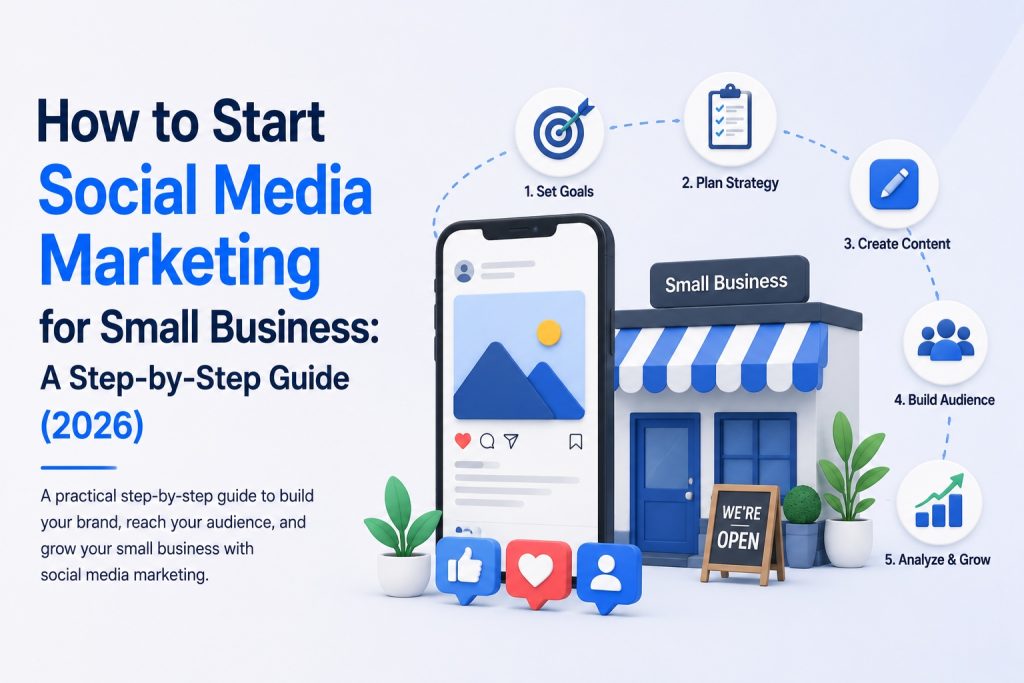
Starting social media marketing for your small business feels overwhelming until you break it into steps.
Most small business owners either do too much at once and burn out within two months, or do too little and wonder why nothing is working. Neither approach is your fault. It is just that nobody gave you a clear starting point.
This guide does exactly that. Each step builds on the one before it. Follow them in order and by the end you will have a real social media presence that is built to grow, not just exist.
Step 1: Define Your Goal Before You Post Anything
The single most common reason small businesses get poor results from social media is that they start posting without knowing what they are trying to achieve.
Posting without a goal produces activity without direction. You stay busy, nothing grows, and eventually you conclude social media does not work for your type of business. It does. You just need a clear goal first.
The four goals most small businesses should choose between:
- Brand awareness – You want more people in your area or niche to know your business exists. Success looks like follower growth, reach, and profile visits.
- Lead generation – You want people to enquire, book a call, or fill out a contact form. Success looks like DMs, link clicks, and form submissions.
- Direct sales – You want people to buy from your online store or book directly through social media. Success looks like conversions and revenue attributed to social.
- Customer retention – You want existing customers to keep coming back and refer others. Success looks like engagement from existing customers and repeat bookings.
Pick one primary goal for the first three months. You can layer in more later. Starting with one keeps your content focused and your progress measurable.
Step 2: Get Specific About Who You Are Talking To
Your content will only ever be as effective as your understanding of the person it is written for.
“Everyone” is not a target audience. Neither is “small business owners” or “people who like fitness.” The more specifically you can describe the person you are trying to reach, the better your content will perform.
Questions to answer before you write a single post:
- How old are they and what do they do for work?
- What problem are they trying to solve right now?
- What have they already tried that did not work?
- Where do they spend time online and what do they scroll past versus stop for?
- What would make them choose you over someone else?
Write down a one-paragraph description of your ideal customer. Name them if it helps. Every piece of content you create from this point forward should be written with that specific person in mind. Not the widest possible audience. One person.
This step feels slow. It is actually the fastest thing you can do to improve your results.
Step 3: Choose One Platform and Start There
Here is the advice that will save you months of wasted effort: do not start on every platform at once.
Pick one. Learn it properly. Build a real presence there before you expand anywhere else. Three great posts a week on one platform will always outperform one mediocre post a week across five.
How to choose the right platform:
- Instagram – Best for visual businesses: food, fashion, fitness, beauty, design, real estate, and any product that photographs well. Strong with audiences aged 18 to 44.
- Facebook – Best for local businesses, community-focused brands, and audiences over 35. Facebook Groups are particularly effective for building repeat engagement around a niche.
- TikTok – Best for businesses that can create entertaining or educational short-form video. Audiences skew younger but the organic reach is the strongest of any platform right now.
- LinkedIn – Best for B2B businesses, consultants, coaches, and professional service providers trying to reach decision-makers and other business owners.
- YouTube – Best for businesses whose product or service benefits from longer explanation: tutorials, how-to content, product reviews, and educational series.
- Pinterest – Best for home decor, food, weddings, fashion, and DIY. Strong with female audiences and functions more like a search engine than a social feed.
Pick the platform where your target customer actually spends time, not the one you personally prefer using.
Step 4: Set Up Your Profile the Right Way
Your social media profile is the first thing a potential customer sees when they find you. Most small business profiles leave a bad first impression without realizing it.
A strong profile does one job: it tells the right person immediately that they are in the right place.
Profile optimization checklist:
- Profile photo – Use your logo if you are building a brand. Use a clear, professional headshot if you are the face of the business. Avoid blurry, cropped, or outdated images.
- Username – Keep it consistent across platforms and as close to your business name as possible. Consistency makes you easier to find and tag.
- Bio or about section – State clearly what you do, who you do it for, and what someone gets by following you. “Helping first-time homebuyers in Austin find their perfect home” beats “Real estate agent. DM for inquiries” every time.
- Link in bio – Point it to your most important page: your booking link, shop, or lead form. Update it when you run a campaign or promotion.
- Contact information – Make sure your phone number, email, and location are filled in completely. Customers who cannot find how to contact you will not work hard to figure it out.
- Highlights (Instagram) – Use Story Highlights to store your best testimonials, FAQs, services, and before-and-after content so new visitors can access them immediately.
Spend an hour getting your profile right before you post a single piece of content. It changes how everything else performs.
Step 5: Build a Simple Content Plan
You do not need a complicated editorial calendar. You need a simple, repeatable system that stops you from staring at a blank screen every time you sit down to post.
The easiest way to build one is to define three to four content types you will rotate through, with a clear purpose for each.
A simple content rotation for small businesses:
- Educational post (1-2x per week) – Teach your audience something specific and useful related to your product or service. This builds authority and gets saves.
- Engagement post (1x per week) – A question, poll, or interactive post designed to get comments and shares. This signals to algorithms that your content is worth distributing.
- Trust-building post (1x per week) – A testimonial, case study, before and after, or behind-the-scenes post that builds credibility with people who do not know you yet.
- Promotional post (1x per week or less) – A direct mention of your product, service, or offer with a call to action. Keep these less frequent than the others so your feed does not feel like an ad.
Map out two weeks of content using this rotation before you start posting. Having content planned in advance is the difference between consistent presence and sporadic activity.
For specific post ideas to fill your content plan, this list of social media marketing ideas for small businesses covers 25 post types with real examples for each one.
Step 6: Create Content That Actually Stops the Scroll
Knowing what to post is one thing. Creating content that people actually pause on is another.
The first line of every post and the first frame of every video is doing the most important job. If it does not earn attention in the first two to three seconds, the rest of the post does not matter because nobody reaches it.
What makes content stop the scroll:
- A specific claim or statement that creates immediate curiosity (“We turned down a $15,000 client last year. Here is why it was the right call.”)
- A striking visual that is relevant to the caption (not stock photography, real images from inside your business)
- A direct question that the reader has an immediate opinion on (“What is the one thing you wish you knew before starting a business?”)
- A clear, specific promise (“Here is the exact email template we used to get a 60% reply rate from cold outreach.”)
What you need to create good content consistently:
- A smartphone with a decent camera is enough for most social platforms. You do not need professional equipment to start.
- Canva covers graphics, carousel posts, Story templates, and simple video editing for free.
- Natural light beats studio lighting for almost every type of small business content.
- Batch your creation. Set aside two to three hours once a week to create all your content for that week. Scheduling tools like Buffer or Hootsuite let you plan and automate publishing.
Step 7: Post Consistently and Engage Every Day
Consistency is the variable that separates small businesses that grow on social media from those that plateau. It is not talent, budget, or even content quality. It is showing up reliably over time.
A realistic posting schedule for small businesses starting out:
- Instagram: 4 to 5 times per week
- Facebook: 3 to 4 times per week
- TikTok: 3 to 5 times per week if you are doing video
- LinkedIn: 3 to 4 times per week
- Google Business Profile: 1 to 2 times per week
Beyond posting, spend 15 to 20 minutes every day engaging. Reply to every comment on your posts. Respond to DMs promptly. Leave real, thoughtful comments on posts from accounts your target audience follows. This daily engagement is what builds genuine community and tells algorithms that your account is active and worth promoting.
The goal in the first three months is not growth. It is building the habit and the baseline. Growth follows consistency, not the other way around.
Step 8: Understand What the Numbers Are Telling You
You do not need to be a data analyst to measure social media performance. You need to check a handful of numbers regularly and use them to make better decisions about what to post next.
The metrics that actually matter for small businesses:
- Reach and impressions – How many people are seeing your content. If this is low, your hook or posting time needs work.
- Engagement rate – The percentage of people who saw your post and interacted with it. Above 3% is healthy for most platforms. Below 1% means the content is not resonating with your audience.
- Profile visits – How many people clicked through to your profile after seeing a post. High profile visits mean your content is creating curiosity.
- Link clicks – How many people clicked the link in your bio or a Story link. This directly measures how well your social content is driving traffic to your website or booking page.
- Follower growth – Are you gaining followers consistently week over week? Sudden drops often point to a content shift that is not landing.
Check your analytics once a week. Look for patterns. Double down on the content types that drive the most engagement, profile visits, and link clicks. Quietly retire the formats that consistently underperform.
To understand how these signals translate into real business outcomes and revenue, this breakdown of how social media has impacted marketing for small businesses puts the numbers in context.
Step 9: Add Paid Advertising Once Your Organic Foundation Is in Place
Many small businesses make the mistake of jumping straight to paid ads before they have established an organic presence. That is an expensive shortcut that usually underperforms.
Paid social works best when it amplifies content that is already resonating organically and pushes it to a larger, precisely targeted audience.
When you are ready to run your first paid campaign:
- You have been posting consistently for at least six to eight weeks
- You have at least one piece of organic content that performed well (high engagement, saves, or profile visits)
- Your profile is fully optimized with a clear call to action and working link
- You know exactly who you want to target and what action you want them to take
Starting paid social the right way:
- Start with a small daily budget of five to ten dollars to test before scaling
- Run your first campaign as a boosted version of your best-performing organic post
- Use the targeting tools to narrow your audience by location, age, interest, and behavior
- Set one clear objective per campaign: reach, traffic, leads, or conversions
- Run each campaign for at least seven days before drawing conclusions and making changes
For a more detailed look at how to build the full marketing system that paid ads slot into, this complete guide on social media marketing strategies for small businesses covers the bigger picture.
Step 10: Keep Improving Based on What You Learn
Social media marketing is not a set-it-and-forget-it task. It is a process of ongoing refinement based on what the data and your audience tell you.
Every month, take 30 minutes to review:
- Which content types performed best and why
- Which platform is driving the most profile visits and link clicks
- Whether your follower growth is trending in the right direction
- What your competitors are doing that is working and whether any of it is relevant to your audience
- Whether your original goal from Step 1 is still the right one or if it needs adjusting
Small businesses that treat social media as a learning process consistently outperform those that treat it as a task to complete. The ones that review, adjust, and improve every month end up with a compounding advantage over time.
Not Sure Where to Start or Short on Time?
Building a social media presence from scratch while running a business is genuinely hard. Most small business owners know what they want to achieve but struggle to find the time and consistency to make it happen.
If that sounds like you, our social media marketing services for small businesses are built specifically for this situation. We handle the strategy, content creation, posting, and performance tracking so you can focus on running your business while your social presence grows.
The Bottom Line
Starting social media marketing for your small business does not require a big budget, a design team, or hours of daily effort. It requires clarity about who you are talking to, a simple content system you can stick to, and enough consistency to let results compound over time.
Follow these ten steps in order. Start with one platform. Build the habit before you build the budget. And keep showing up even when early results feel slow.
The small businesses that grow on social media are not the ones that started perfectly. They are the ones that started, kept going, and got better as they went.