
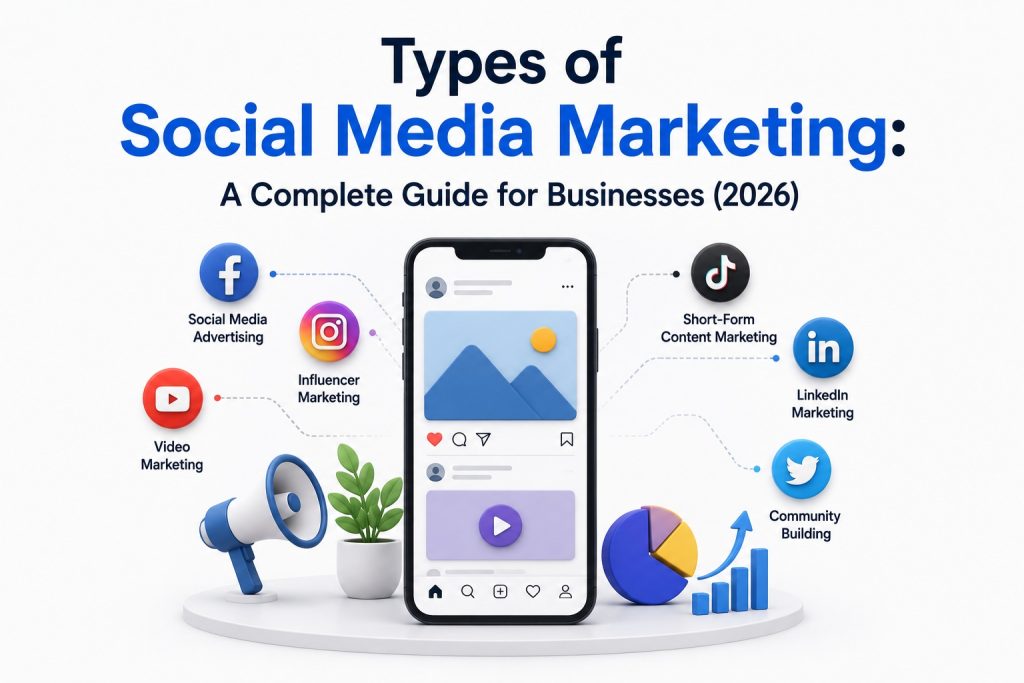
Most businesses know they need to be on social media. Very few know that “social media marketing” is not one thing. It is at least eight different things, each with its own approach, its own audience behavior, and its own way of generating results.
Throwing content at Instagram and calling it a social media strategy is like throwing ingredients at a pan and calling it cooking. The outcome depends entirely on knowing what you are working with.
This guide covers every type of social media marketing, what each one actually involves, when to use it, and what businesses get wrong about each one.
1. Organic Social Media Marketing
Organic social media marketing is everything you post without paying to promote it. Your regular posts, Stories, Reels, carousels, and threads that reach your existing followers and whatever new audience the algorithm sends your way.
What it includes:
- Feed posts (photos, carousels, text posts)
- Stories and ephemeral content
- Short-form video (Reels, TikTok videos, YouTube Shorts)
- Long-form video (YouTube, LinkedIn video)
- Polls, Q&As, and interactive content
- Pinned posts and profile optimization
When it works best:
- Building brand awareness and personality over time
- Nurturing an existing audience between purchases or appointments
- Establishing expertise and trust before asking for anything
- Growing a community that keeps coming back
What most businesses get wrong:
Posting inconsistently and expecting consistent results. Organic social media is a long game. The businesses that win at it show up with useful, specific, interesting content on a reliable schedule. The ones who post three times in a week and then disappear for a month build nothing.
The other mistake is posting content that could belong to any business. Your organic content should feel like it could only come from you. Your voice, your team, your real opinions, your actual results.
Best platforms for organic: Instagram, TikTok, LinkedIn, Facebook, YouTube, Pinterest
2. Paid Social Media Advertising
Paid social media advertising means paying platforms to show your content to people who do not follow you yet, or to amplify it to people who do. It is the fastest way to reach a large, targeted audience and the most controllable type of social media marketing in terms of who sees what and when.
What it includes:
- Facebook and Instagram Ads (Meta Ads Manager)
- LinkedIn Ads (sponsored content, lead gen forms, message ads)
- TikTok Ads (in-feed ads, TopView, branded hashtag challenges)
- Pinterest Ads (promoted pins, shopping ads)
- YouTube Ads (pre-roll, mid-roll, bumper ads)
- X (Twitter) Ads (promoted posts, trend takeovers)
- Snapchat Ads
The core ad types across most platforms:
- Awareness campaigns – Reach as many people in your target audience as possible, optimized for impressions or reach
- Consideration campaigns – Drive traffic, video views, or engagement from people likely to want what you offer
- Conversion campaigns – Get purchases, sign-ups, bookings, or leads from people most likely to act
When it works best:
- Launching a new product, service, or location
- Targeting a very specific audience (by job title, age, location, interest, or behavior)
- Scaling what is already working organically
- Retargeting people who visited your website but did not convert
What most businesses get wrong:
Running ads to a cold audience with no prior brand awareness and expecting them to convert immediately. Paid social works best in layers. Awareness ads warm people up. Retargeting ads close them. Skipping the first step and going straight to “buy now” ads to strangers is how budgets disappear with nothing to show.
The creative is also where most ads fail. An ad that looks like an ad gets skipped. The best performing social ads look like native content: real people, real scenarios, direct and specific copy, no stock photo energy.
Best platforms for paid ads: Meta (Facebook and Instagram), LinkedIn for B2B, TikTok for younger audiences, YouTube for video-first products
3. Influencer Marketing
Influencer marketing means partnering with individuals who have built an audience that trusts them, and having them create content about your product or service to that audience.
It is not about finding the person with the most followers. It is about finding the person whose audience is the most aligned with your customer, and whose recommendation that audience actually acts on.
The influencer tiers that matter:
- Nano influencers (1,000 to 10,000 followers) – Highest engagement rates, strongest community trust, most affordable, best for local or niche products
- Micro influencers (10,000 to 100,000 followers) – Strong niche authority, high engagement, often better ROI than larger influencers
- Macro influencers (100,000 to 1 million followers) – Broad reach, established credibility, higher cost
- Mega influencers and celebrities (1 million+) – Massive reach, very high cost, often lower engagement rates relative to audience size
Types of influencer partnerships:
- Sponsored posts and Reels
- Product gifting and organic reviews
- Brand ambassador programs (long-term partnerships)
- Affiliate arrangements (influencer earns a commission on sales they drive)
- Influencer takeovers of your social accounts
- Co-created content or product collaborations
When it works best:
- Consumer products with a clear visual appeal
- Reaching a specific niche that is hard to target through ads
- Building trust with an audience that is skeptical of traditional advertising
- Launching a new product and needing social proof quickly
What most businesses get wrong:
Choosing influencers based on follower count instead of audience alignment. A beauty influencer with 500,000 followers promoting a B2B software tool will generate zero meaningful results. A micro influencer with 12,000 highly engaged followers in exactly your target niche will consistently outperform them.
Also: briefing influencers too rigidly. The best influencer content sounds like the influencer, not like a press release. Give them the key points and let them translate it into their own voice.
4. Content Marketing on Social Media
Content marketing on social media is the practice of creating genuinely useful, educational, or entertaining content that builds trust and authority over time, rather than pushing a direct sales message.
This is different from just “posting.” Content marketing on social has a strategy behind it: specific topics, specific formats, specific audiences, and a clear connection between what you publish and who you are trying to attract.
What it includes:
- Educational carousels breaking down how something works
- Behind-the-scenes content showing your process or team
- Case studies and results shared in post format
- Opinion posts and industry takes that show your expertise
- How-to videos and tutorials
- Data and research posts (“we analyzed 100 of our clients and found this”)
- Myth-busting content challenging common misconceptions
When it works best:
- Businesses with a longer sales cycle where trust matters before purchase
- Service businesses where expertise is the product
- B2B companies trying to reach decision-makers over time
- Any brand trying to build an audience rather than just run campaigns
What most businesses get wrong:
Creating content about what they want to talk about instead of what their audience wants to know. Before writing a single post, the question to answer is: what does my specific customer need to understand, believe, or feel before they are ready to buy from me? Every piece of content should move them closer to that point.
If you are still figuring out what social media marketing fundamentally involves before building a content strategy, this primer on what is social media marketing lays the groundwork clearly.
5. Community Management and Engagement Marketing
Community management is the type of social media marketing that happens in the comments, DMs, replies, and group conversations, not just in the content you publish.
It is the difference between broadcasting to an audience and actually talking to one.
What it includes:
- Responding to every comment on your posts (especially in the first hour after posting, which signals the algorithm to push your content further)
- Answering DMs and questions promptly
- Engaging with followers’ own content by commenting and sharing
- Managing and growing a Facebook Group, LinkedIn Group, or Discord community
- Monitoring brand mentions and joining conversations about your industry
- Running interactive content: polls, Q&As, “this or that” posts, AMAs (Ask Me Anything sessions)
When it works best:
- Brands that want loyalty and word-of-mouth, not just reach
- Service businesses where relationships drive referrals
- Any brand in a competitive space where trust is the differentiator
- Local businesses building a community presence
What most businesses get wrong:
Treating engagement as an afterthought. Publishing content and never responding to the people who comment on it sends a clear message: we broadcast, we do not listen. That kills community growth faster than almost anything else.
The brands that build the most loyal social followings are not always the ones with the best content. They are the ones that make their followers feel seen, heard, and appreciated.
6. Social Commerce
Social commerce is selling products directly through social media platforms, without the customer needing to leave the app to complete a purchase.
It has become one of the fastest-growing types of social media marketing as platforms build out native shopping features that reduce the friction between discovery and purchase.
What it includes:
- Instagram Shopping (product tags in posts and Stories, Instagram Shop tab)
- Facebook Shops and Facebook Marketplace
- TikTok Shop (in-feed shoppable videos, LIVE shopping)
- Pinterest Shopping (product pins, shopping spotlights)
- YouTube Shopping (product shelves below videos, shoppable livestreams)
When it works best:
- E-commerce brands with a visually appealing product
- Consumer goods with an impulse-buy element
- Brands with strong video or visual content that naturally showcases the product in use
- Businesses targeting audiences that spend significant time on mobile
What most businesses get wrong:
Setting up a shop and waiting for sales to happen. Social commerce works when the content around the shop drives desire. The product tag is the last step. The Reel showing the product in a real context, or the TikTok showing the result it delivers, is what makes someone tap the tag in the first place. Social commerce is still content marketing at its core.
7. Influencer and User-Generated Content (UGC) Marketing
User-generated content marketing means encouraging and amplifying content created by your actual customers rather than your brand account.
UGC is different from influencer marketing because it is not paid or arranged. It is what real customers create when they genuinely like what you do: unboxing videos, reviews filmed in their living room, photos of your product in real life, posts tagging you because they wanted to share something.
What it includes:
- Reposting and resharing customer content on your own channels (with permission)
- Running campaigns or contests that encourage customers to create content
- Using customer reviews as social media posts
- Featuring customer stories in your content
- Hashtag campaigns that aggregate community-created content
Why it works:
UGC is the most trusted form of social media content that exists. Nielsen research consistently shows that people trust recommendations from other consumers far more than they trust content created by brands. A photo of your product posted by a real customer converts at a higher rate than a polished brand photoshoot because it feels real.
When it works best:
- Products with a strong visual or emotional element
- Brands with a loyal existing customer base
- Businesses looking to scale content creation without scaling the content budget
- Any brand trying to build social proof at volume
8. Video Marketing on Social Media
Video is not just one type of social media content. It is a category of its own that spans short-form, long-form, live, and animated formats across every major platform.
It deserves to be treated as a distinct type of social media marketing because video consistently outperforms static content in reach, engagement, watch time, and conversion across almost every platform and industry.
The formats that matter:
- Short-form video (under 90 seconds): TikTok, Instagram Reels, YouTube Shorts. Best for hooks, entertainment, quick tips, product reveals, and trend-driven content.
- Long-form video (2 to 20 minutes): YouTube primarily. Best for tutorials, in-depth product demos, expert interviews, and educational series.
- Live video: Instagram Live, Facebook Live, TikTok LIVE, YouTube Live. Best for product launches, Q&As, behind-the-scenes, and community events.
- Stories: Instagram Stories, Facebook Stories. Ephemeral (disappears in 24 hours), best for day-to-day updates, polls, limited-time offers, and authentic glimpses.
When video marketing works best:
- Any product or service that benefits from being seen in action
- Brands trying to build a personal connection between their team and their audience
- Businesses in competitive markets where trust is the deciding factor
- Any brand trying to improve their organic reach, since video content receives preferential algorithmic treatment on almost every platform
What most businesses get wrong:
Waiting until they have a proper camera, a script, and a production setup. The most effective social video is often filmed on a phone in natural light with a person talking directly to camera. Over-production can actually reduce trust. Authenticity outperforms polish on social media consistently.
9. Social Listening and Reputation Marketing
Social listening means monitoring what people are saying about your brand, your competitors, and your industry across social platforms, even when they do not tag you directly.
Reputation marketing on social means actively shaping how your brand is perceived through what you post, how you respond, and how you handle criticism publicly.
What it includes:
- Monitoring brand mentions using tools like Hootsuite, Sprout Social, or Brandwatch
- Tracking competitor mentions and industry conversations
- Responding to negative reviews and comments in public, professionally and promptly
- Amplifying positive mentions and reviews
- Identifying trends and conversations your brand can authentically contribute to
When it works best:
- Brands in competitive industries where reputation is a key buying factor
- Local businesses where Google and Facebook reviews drive a significant portion of new business
- Any business that has gone through a reputation challenge
- Brands trying to understand what their customers actually think, not what they say in a survey
What most businesses get wrong:
Treating reputation management as a crisis response tool rather than a proactive strategy. The businesses with the strongest social reputations did not build them by responding well to problems. They built them by consistently engaging, acknowledging, and delivering on their promises long before any problem occurred.
How to Choose the Right Types of Social Media Marketing for Your Business
Not every type of social media marketing is right for every business at every stage. Here is how to think about it:
If you are just starting out:
- Organic content marketing is your foundation. Get clear on who you are talking to, what you want to be known for, and what you will consistently post before spending anything on ads.
If you have an existing audience but want more reach:
- Paid social advertising amplifies what is already working. Do not run ads on content that performs poorly organically.
If you sell a consumer product:
- Social commerce, UGC, and influencer marketing are worth prioritizing alongside organic content.
If you are a service business or B2B:
- Content marketing, community management, and LinkedIn-focused organic and paid strategies will serve you better than social commerce.
If you want to build long-term brand loyalty:
- Community management and engagement marketing are non-negotiable. Content without conversation builds an audience. Conversation builds a community.
For businesses just starting to build their strategy, this guide to social media marketing strategies for small businesses breaks down how to prioritize and sequence these approaches when resources are limited.
And before you commit budget to any of these channels, knowing how to measure what is actually working is critical. This breakdown of how to measure the ROI of social media marketing covers the metrics that actually matter for each channel type.
If you want a team to assess which types of social media marketing make the most sense for your specific business and build the strategy and content around it, our best social media marketing services are designed to take the guesswork out of the entire process.
The Bottom Line
Social media marketing is not one tactic. It is a toolkit with nine different tools, each built for a different job.
The businesses that grow on social media are not the ones doing the most. They are the ones who understood which types of social media marketing fit their audience, their goals, and their resources, and then executed those well and consistently.
Pick the types that fit where you are right now. Build the foundation before layering in complexity. And measure what is working so you can do more of it.